
The Obama Legacy Carries Through Loud and Clear
The Obama Legacy Carries Through Loud and Clear
When President Obama took office in 2009 promising hope and change, he did so amidst the fallout from a recession that left many in the country reeling. Part of that vision was an improved public education system that would prepare all students for success in the 21st century—regardless of race, zip code or financial situation. From K-12 to higher education, the benefits of his policies are clear: we have seen an increase in high quality public school options that empower parents to choose the right school for their child; strengthened standards and accountability to measure progress and success; and intentionality in addressing racial and social inequities.
We must protect and build upon this progress.
In the face of our current Administration that has proven time and time again that it does not have the best interest of all children at heart, it is imperative that we continue to champion President Obama’s agenda. At Democrats for Education Reform (DFER), we are proud to stand in the legacy of President Obama and will continue to champion these common-sense education reforms that get results, including around high quality public school options. Below, please find recent examples of interviews where DFER President Shavar Jeffries espouses our organizational values and positions on these critical issues.
“‘We champion what we call the Obama Agenda, which is broadly supported by Democrats, broadly supported by voters.’ …
‘There’s overwhelming support again, particularly among African Americans and Latinos, for a wide range of choice within the public education system, including public charter schools. There’s strong evidence for holding politicians accountable to make sure that schools work for kids, that there’s many options, and that parents are at the center of making decisions about the option that best serves their children.'”
“Shavar Jeffries, the president of Democrats for Education Reform, a national organization that supports alternatives to traditional public schools, said there were still prominent Democrats, like Senator Booker, Gov. Jared Polis of Colorado and Gov. Andrew M. Cuomo of New York, whom he considered strong supporters of the charter school sector. And at the local level, he said, many Democratic mayors and state legislators continued to support charter schools, especially those offering additional options for low-income black and Latino students, like those in Los Angeles.
‘Charters exist because the parents demand them and want them,’ Mr. Jeffries said. ‘I do wish more leaders would step up and stand up and deliver that message.'”
“‘There’s a distinction between Obama-style charter schools, which are public and have accountability measures, and Trump-DeVos style, which are for-profits and don’t,’ explains Shavar Jeffries, the president of Democrats for Education Reform, a group that, like Obama and Booker, advocate public charters as a means for education improvement.
“‘None of that would have happened without Sen. Booker,’ Shavar Jeffries, president of Democrats for Education Reform, says. ‘Mayors tend to try to shy away from public education precisely because it’s so hard. He leaned in and leaned in in a very bold and aggressive way.’ …
Jeffries says he hopes Booker will embrace his record on school choice, and points to recent polling his group tapped Benenson Strategy Group to perform that found large majorities of Democratic primary voters support school choice and that more than 80 percent of black and Latino Democratic primary voters support school choice and increased investments in public education.
‘If he embraces this agenda, the evidence shows that this will resonate with large proportion of Democratic primary voters,’ Jeffries says.”
DFER Condemns Governor Haslam for Skipping Another Year of Accountability for Tennessee Schools
DFER Condemns Governor Haslam for Skipping Another Year of Accountability for Tennessee Schools, Calls on Secretary DeVos to Closely Review this Decision that Harms Tennessee Children
Decision Marks the Second Time in Three Years that Tennessee Skirts Accountability, This Time Mere Months After the Volunteer State’s ESSA Plan – Contingent on Assessments – Was Approved by Education Secretary DeVos
Washington, D.C. – Democrats for Education Reform (DFER) today responded to the news that Governor Bill Haslam signed a bill last week suspending the use of accountability assessments for schools statewide for the 2017-18 school year, less than eight months after Tennessee’s ESSA plan was approved by U.S. Secretary of Education Betsy DeVos. This marks the second time in three years that the state has waived consideration of student achievement in rating schools and targeting limited federal and state funding to students and classrooms most in need.
“Wouldn’t it be great if we could skip our annual reviews at work and avoid the discomfort of getting the feedback necessary to get better at what we’re paid to do?” said Charles Barone, National Policy Director for Democrats for Education Reform. “That’s what Governor Haslam and the Tennessee legislature have just done for those charged with the responsibility of providing high-quality educational opportunities for every child. Sadly, the victims of this escape from accountability are Tennessee’s schoolchildren and in particular, low-income students and students of color who are most in need of the support and funding that should be directed to schools where students are falling the furthest behind.”
Tennessee’s retreat on school quality began in 2014 when Governor Haslam abruptly pulled the state out of the PARCC test. In 2016, the state selected a new testing vendor that, not surprisingly given clear red flags about its competence, botched test administration. Problems continued last year with yet another vendor (Questar) that the state has obviously failed to resolve in light of this year’s glitches. This may be why, after years of progress, Tennessee’s scores on the National Assessment of Education Progress flat-lined on the recently released national report card.
“Governor Haslam and Superintendent McQueen should demand that lawmakers go back to the drawing board even if that means calling a special legislative session in which these policies could be debated and decided thoughtfully, responsibly, and publicly” said Barone. “If, instead, the state remains stubbornly attached to this policy, then the ESSA statute is unambiguously clear that Tennessee must seek and obtain approval from Secretary DeVos who we hope will set aside partisanship and fully exercise her responsibility in this regard by asking tough questions and seeking a solution that best serves Tennessee’s students, parents, and taxpayers.”
###
The Many Trump Universities
Donald Trump has been making front page news again, this time for Trump University amid comments from former instructors and students describing the institution as “a fraudulent scheme” and “a total lie.”
We ought not get caught up in the idea of Trump “University” being an actual institution of higher learning, however. It granted no degrees, held no accreditation, and received no direct taxpayer money. It was simply your standard get-rich-quick business scheme.
Surprising parallels do exist, however, between Trump’s venture and actual colleges and universities that do grant degrees, do hold accreditation, and do receive substantial taxpayer support.
For years, degree and certificate granting, accredited for-profit colleges that get billions in federal funds have used many of the same recruiting tactics, organizational structures, and sales pitches as Trump University. In fact, many proprietary schools exploit the same low-income people – bottom feeding off of the hopes and dreams of folks who find themselves in dire financial situations. See the video below for examples.
And just like Trump University, the results at most for-profit colleges have been disastrous. A study released just this week revealed that associate’s and bachelor’s degree-seeking students attending for-profit colleges like the University of Phoenix, “…experience a decline in earnings after attendance.”
You might think it’s the “profit” part of Trump University and the for-profit education business model that’s the problem. Whereas not-for-profit schools are theoretically liable to those they serve, for-profit institutions are accountable to shareholders. Profit comes before education in their eyes.
Guess what, though? Non-profit colleges are not always so great.
According to a recent report by Third Way, the average private non-profit college graduates only 55 percent of freshmen within a six-year period. On average, only 63 percent of students with federal loans earned more than the average high school graduate without a college degree six years after starting.
We see similar stories with colleges in the public sector. Consider Ohio University-Southern, for example, that has only a 12 percent graduation rate– again measured six years from initial enrollment, not four. In fact, there are over two dozen other public colleges and universities that have six-year graduation rates below 20 percent.
Obama’s legacy on this issue is clear.
The most lasting aspect of President Obama’s higher education agenda just might prove to be heightened examination of college and student outcomes in addition to work on traditional access and affordability issues. At the forefront of Obama’s college quality efforts were his executive actions to ensure minimal standards for post-secondary vocational programs.
Based on his initiatives, including language that clearly defined “gainful employment,” spending on instructional services instead of marketing, sales, and raw profit at for-profit colleges is up 25 percent. Degree completion rates at four-year for-profit colleges are up nearly 40 percent.
By and large, all colleges – whether they are for-profit, non-profit, or even public – need federal funds in to survive. But they shouldn’t get a blank check from the federal government to take in students, add to the already growing amount of national student debt in this country, and then not be held accountable for failing to provide their students with meaningful opportunities to make a living post-enrollment.
So here’s our challenge for the next President:
Minimum quality standards for institutions of higher education should be set in exchange for access to federal funds. Give colleges time and help to improve first, but improve they must. A 12 percent graduation rate, or put another way, an 88% dropout rate year after year with no improvement is not acceptable.
Scams like Trump University exist in our real higher education system as well. And like Trump University, many colleges have faced or eventually will face an existential crisis.
Steven Isaacson is a Research and Communications intern with Education Reform Now.
DFER Joins Letter to Secretary John King: Enforce ESSA’s Supplement Not Supplant Requirement
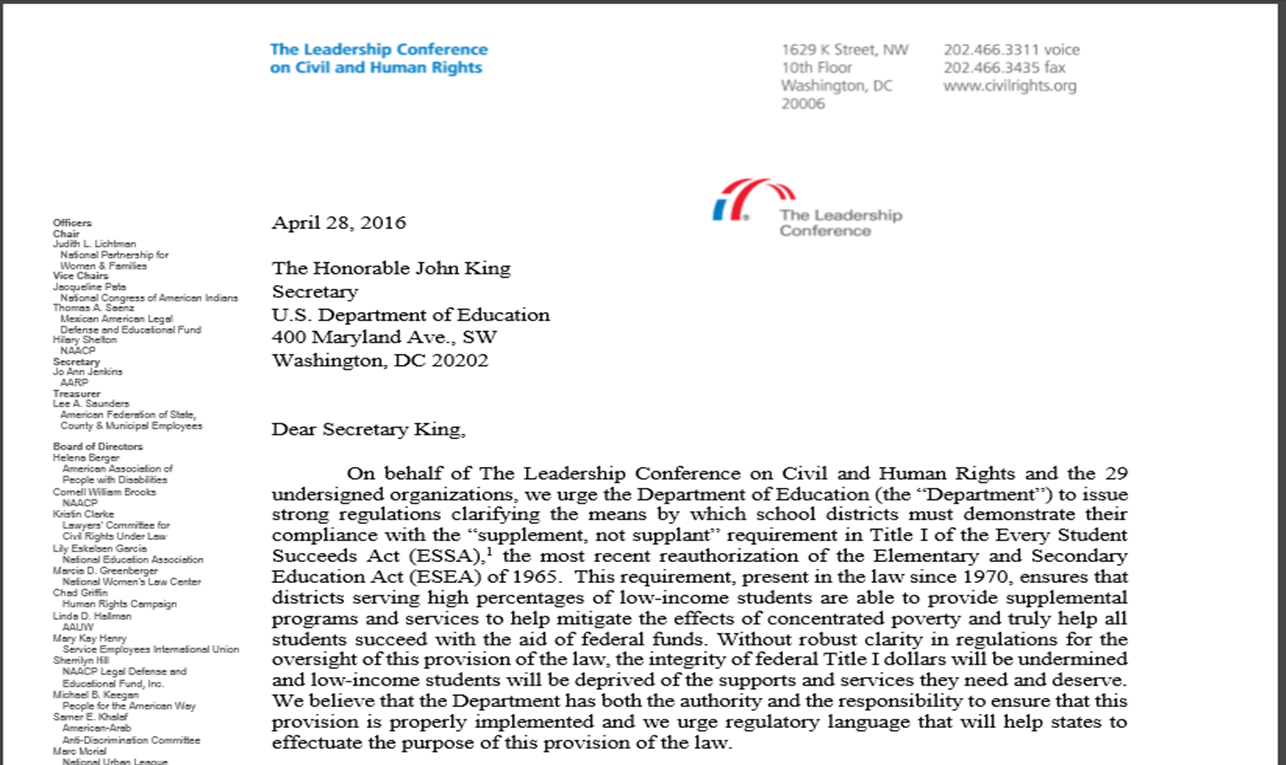
It wasn’t long ago that states like Mississippi admitted that Title I funding was used to build and equip cafeterias and libraries, to hire teachers, and to provide instructional materials and books to Black students that had long been available to White students. This is known in technical terms as “supplanting,” which, albeit less blatantly, many states and districts still do due to weak regulatory oversight. Read the letter we co-signed today with the Leadership Conference on Civil and Human Rights, the NAACP, NCLR, and others urging USDOE, once and for all, to end this shell game and enforce the law’s requirement that Title I funds supplement, not supplant, state and local resources intended for low-income and minority students.
A Parent’s Heartbreak to See College Dreams Crushed
By Marianne Lombardo
There’s no heartbreak worse than seeing your child struggle. And when they struggle to make a successful college transition, it can impact the rest of their life. In my son’s case, the public K-12 schools and the college of his dreams got paid, but he got a pink slip.
Like all parents, I wanted my kids to achieve success in life. I very purposefully moved us to one of the highest-performing (and very expensive, greatly stretching our middle-class income) suburban districts in the state to assure they would get a good education.
My son’s school experience was generally good. He got mostly good grades and easily passed the Ohio Graduation Test the first time without any issues (attaining a $500 college stipend the state provided). We found a public four-year college with a program that perfectly matched his interests and felt great that we did all we were supposed to do to launch him toward the career of his dreams.
But, it all crashed down. He only attended one quarter. He left because, surprisingly, he was not prepared for the academic demands of college. It was a surprise because it had never been pointed out by his suburban high school that his writing skills were not up to college readiness standards. That surprise deficit did him in.

The program my son wanted to enroll in at college required students to attain an “A” or “B” in a required introductory course taken during the first quarter. But because of his apparent poor writing skills, he got a “C.” Crushed that he would not be able to attain a degree in the field he had chosen, he dropped out.
My son moved back home with me and enrolled in community college, where he was placed not only in a remedial writing course, but also in a remedial math course. We paid thousands for these courses, to help him relearn what he should have learned in high school, and all the while none of it counted toward a degree. He attended community college on and off for another year and a half before eventually dropping out due to work opportunities and not seeing a clear path toward how college would add value in a career field. He has never finished a college degree and is still paying back student loans.
Our story closely matches data found by my colleagues, Mary Nguyen Barry and Michael Dannenberg, in their report “Out of Pocket: The High Cost of Inadequate High Schools and High School Achievement on College Affordability.”
It really hurts to see your kid not be able to attain his dream.
I feel as if our public education system failed him – both the highly acclaimed “public-private” district (where you can’t attend unless you can afford the $300K housing cost) that didn’t adequately prepare him, and the publicly-funded State University that whiplashes kids that didn’t get an adequate preparation from their high school.
I’m not saying kids should get a free pass, but our education system should be doing everything possible to help kids find success. In our experience, there was a complete lack of alignment between what we were told by the district (get good grades), what we were told by the state (pass the Ohio Graduation Test), and the reality that he did not have college readiness skills. The kicker is that once he graduated high school, the problem was ours alone: there was no responsibility or ownership on the part of the district, the state, or the college. We paid the additional price.
Our state has since increased the rigor of its state assessments, and there’s much more opportunity to get ongoing, honest, and objective feedback on how your child is doing based on these assessments every year they are tested. I hope parents understand the value of this information and use it to help if their own child needs intervention before they are cut loose from the K-12 system.
If we had better information, and if the high school had been required to provide intervention for kids that needed shoring up before they left for college, perhaps we would have been left with more than financial costs and a lifetime of wishes for what could have been.
DC Students and DC TAG Lack Meaningful College Options
By Mary Nguyen Barry
Students and families in Washington, D.C. are stuck between a rock and a hard place.
As in many cities, DC students face a number of education realities specific to an urban public school environment: segregated schools, inequitable facilities, and inequitable school resources.
But unlike most students who successfully navigate the system to high school graduation, students in Washington, D.C. face a challenge unique to the nation’s capital: they have essentially zero “in-state” public college options. All four-year college options are effectively private.
The lack of meaningful in-state public college options is one of the biggest policy issues facing D.C. high school students, said Jessica Cunningham, the principal at KIPP DC College Preparatory in Northeast.
Now technically, students do have options. They can either attend the University of the District of Columbia (UDC) or they can attend a public college out of state and receive a discount provided by the D.C. Tuition Assistance Grant Program (DC TAG).
But let’s be real. Only 6 percent of students graduate from UDC within four years. And the discount provided by DC TAG – a program designed to give D.C. students in-state rates at colleges outside the District – is no longer achieving its goal.
Congress created the DC TAG program in 1999 to expand college choices for D.C. residents. Recognizing the unique challenges faced by the lack of D.C. statehood, Congress provided annual grants of up to $10,000 to cover the difference between in-state and out-of-state tuition at public four-year colleges and universities nationwide (and up to $2,500 per year for public community colleges).
Presumably when the law was originally passed, $10,000 was more than enough to cover the in-state vs. out-of-state difference. But as states have cut financial support of their public colleges and universities in recent years, colleges have jacked up both their in-state and even more so out-of-state tuition rates to compensate. The impact on D.C. students is that their $10,000 voucher is no longer enough to meet the difference in tuition prices. So just as Pell Grants have failed to keep pace with rising college prices, so have the DC TAG grants. And ergo, DC students have another barrier – specifically tied to where they live – to college affordability and completion.
What should one do? A few options are possible:
- Congress could raise the maximum DC TAG amount above $10,000 so the program fulfills its initial goal of providing DC students in-state tuition;
- Congress could raise the maximum DC TAG amount and implement additional minimum college quality provisions to fulfill the broader goal of providing DC students with a meaningful in-state public school option; or
- Congress could implement our Tough Love proposal whereby nonprofit (public and private) college dropout factories like UDC receive extra financial support and assistance to improve graduation rates. But if improvement doesn’t occur after a specified period of time, they lose access to federal financial aid and tax benefits.
Option 1 adheres most closely to the original goal for DC TAG. However, it functions as an inefficient stop-gap measure if college tuition continues to rise. In that sense, it would operate similar to the Pell Grant program that continually fails to keep up with rising college prices. It also misses an opportunity to attack the broader problem that Cunningham noted – the lack of meaningful public options for DC residents.
Option 2 would help boost DC TAG’s purchasing power but also raise the bar on what makes a college eligible for DC TAG funds. Currently all public colleges across the United States are eligible to receive DC TAG funds (a smaller $2,500/year grant to private HBCUs and private colleges in the DC Metropolitan area is also available). But that doesn’t have to be the case. DC TAG could implement minimum institutional eligibility requirements – say only public colleges that fall in the top 95 percent of colleges nationwide in graduation rates or student loan repayment rates may receive DC TAG dollars.
Option 3, in combination with Option 2, would further heighten resources and consequences for low-performing colleges. Let’s help UDC and other college dropout factories improve to become a meaningful option for students instead of a provider most likely to leave them in a worse financial position than had they not enrolled in the first place.
DC residents should not tolerate the fact that the only honest-to-goodness four-year public college within city boundaries has a 6 percent four-year graduation rate.
A meaningful public college option for DC residents and others requires improving the city’s current university and expanding the application of that definition nationwide.
Is the city and Congress, including Congresswoman Eleanor Holmes Norton (D-DC), tough enough to do it? Or will they continue to shortchange deserving DC students from meaningful college opportunities?
Trump: And Liberty for Some
By DFER
The parade of pandering Republican candidates for President continues Monday (MLK Jr. Day) when Donald Trump becomes the latest to visit the evangelical hub known as Liberty University.
These days, most non-right wingers know of Liberty University as the college where – in the wake of the San Bernardino mass shooting – school president Jerry Falwell, Jr. called on students to obtain and carry their own guns on campus.
“Let’s teach them a lesson if they ever show up here,” Falwell told students on Dec. 4th while referencing a Glock pistol in his back pocket, according to the Washington Post’s Nick Anderson.
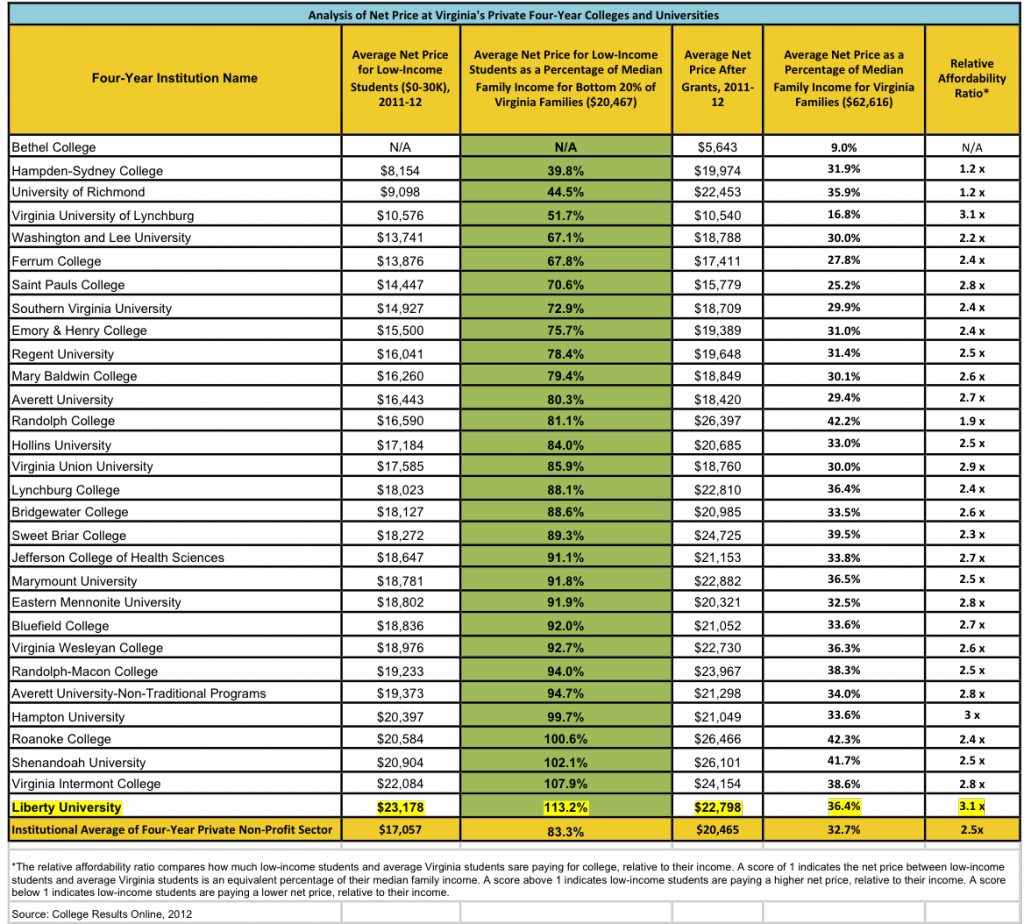
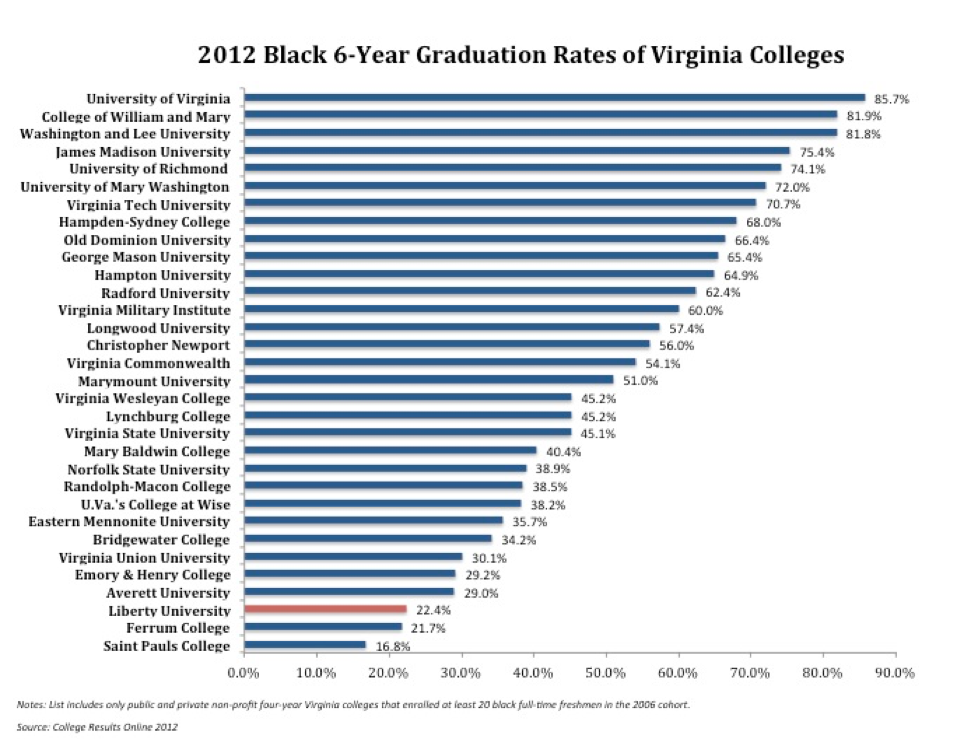
Now when we think of Liberty University, our thoughts focus on, well, education. Liberty University is one of the worst colleges in America for poor and minority students. It has high price, high debt, and deplorable black student completion rates as compared to peer institutions serving similar students. Here are the numbers, according to university-submitted data to the U.S. Department of Education.
High Price & High Debt
Graduation Rates for Black Students
High Price & Low Graduation Rates for Minority Students at Liberty University
As Compared to Peer Colleges Serving Similar Students
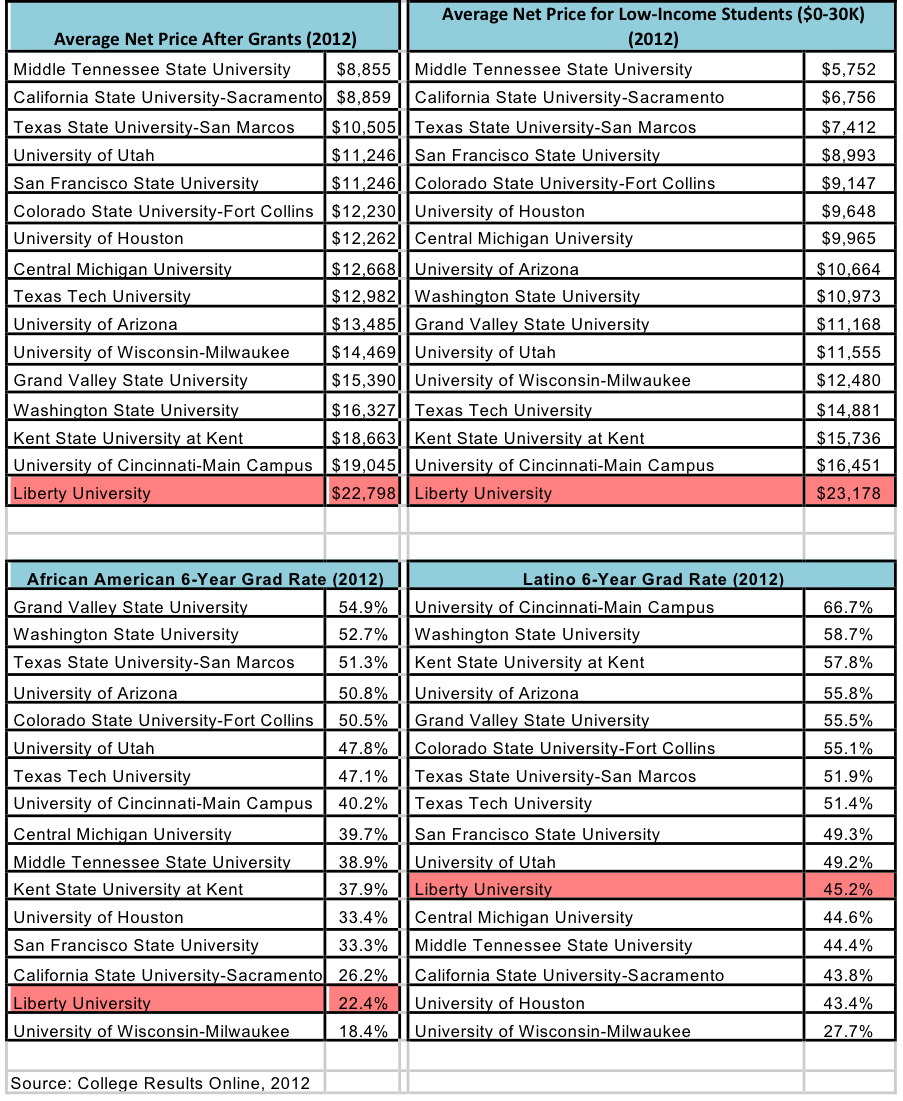
We don’t expect Donald Trump will say anything about Liberty University’s record with minority and low-income students. But someone should. In fact, civil rights accountability hawks should go further and demand Liberty take action or lose some of its very generous federal aid. With liberty comes responsibility.
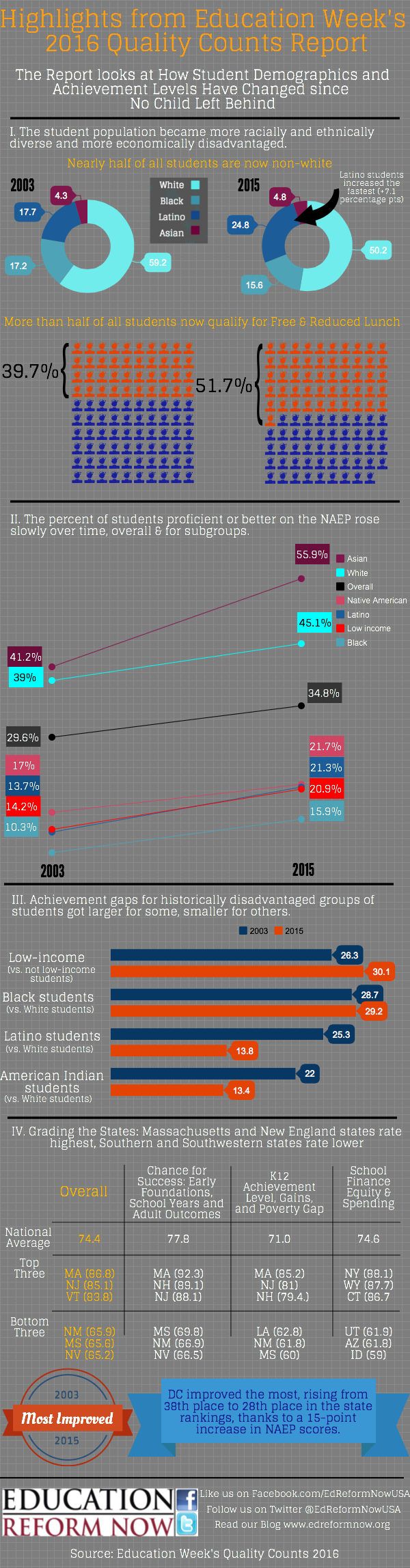
Highlights from Education Week’s 2016 Quality Counts Report
By Marianne Lombardo
Education Week’s annual Quality Counts Report explores different themes throughout the years – such as standards, teaching, early childhood, special education, finance, globalization, and discipline.
The 20th edition, Quality Counts 2016, “Called to Account: New Directions in School Accountability”, takes a deep look at education accountability, an extremely important topic as the nation transitions to new accountability systems under the Every Student Succeeds Act.
The report:
- Examines changes in student demographics and achievement since 2003.
- Grades the states by computing a Chance-for-Success Index, a K-12 Achievement Index, and a school finance analysis for each state, and
- Explores changes in accountability systems we’ll see with the new federal law, where having good data to compare states will be more important than ever.
In a nutshell:
- The student population became more racially and ethnically diverse and more economically disadvantaged;
- Achievement levels for all demographic groups rose slowly over time;
- Achievement gaps between low-income students and their more advantaged peers increased slightly (about 4 percentage points);
- Achievement gaps between black students and their white peers stayed roughly the same;
- Achievement gaps between American Indian and Latino students, and their White, non-Hispanic peers decreased by roughly 50%;
- Massachusetts and other Northeastern states rank high, whereas southern and southwestern states tend to rate lower; and
- DC improved more than any of the 50 states.
Obama’s Crackdown on For-Profit Colleges (VIDEO)
Check out our latest video on for-profit schools and the Obama Administration’s action.
More background on the Obama higher ed legacy and challenges for the next President here.