DFER Applauds Congressional Democrats’ Plan to Boost Teachers’ Salaries

DFER Applauds Congressional Democrats’ Plan to Boost Teachers’ Salaries

NEW YORK, NY – Democrats for Education Reform (DFER) National President Shavar Jeffries today released the following statement on the Congressional Democrats’ plan to increase salaries for teachers:

“Democrats for Education Reform applauds Senate Democratic Leader Chuck Schumer and House Democratic Leader Nancy Pelosi for announcing their plan today to take the tax cuts Republicans gave away last year to the top 1% of all earners and instead use them for salary supports to attract and retain a qualified and diverse teaching force to our nation’s public schools.
This is the kind of high-level investment the public wants to see in our nation’s schools and in our nation’s teachers. The proposal reflects the high esteem in which voters hold our nation’s educators and prioritizes precious funding for policies that will benefit all Americans – not just teachers but students, parents, and a much wider swath of taxpayers – over schemes like the Republican tax bill that award the lion’s share of benefits to an elite group of the most extremely wealthy Americans.
We also hope that, as the details of this bill are fleshed out, care is taken to get highly qualified and ethnically diverse teachers to the schools, subjects, and specialty areas where they are most needed:

  • We need extra pay to attract great teachers to schools in urban and rural areas that have a hard time staffing them.
  • We need salaries that are competitive with the private sector for those professionals with knowledge and expertise in science, technology, engineering, and math (STEM).
  • We need to use salaries to address shortages of teachers with special skills needed to serve students with disabilities and English Language Learners.
  • We need to fund the salaries of beginning teachers who take a year of internship or residency so we know they are maximally prepared before they head up their own classroom.

The public is willing to invest substantially in public education if it feels like it is getting a good return on its investment. We can’t think of any large investment with a better potential return, than one that gets the kinds of teachers we all want for the students that need them most.”
###
CONTACT: Ashley Johnson; ashleyj@dfer.org

DFER Condemns Governor Haslam for Skipping Another Year of Accountability for Tennessee Schools

DFER Condemns Governor Haslam for Skipping Another Year of Accountability for Tennessee Schools, Calls on Secretary DeVos to Closely Review this Decision that Harms Tennessee Children

Decision Marks the Second Time in Three Years that Tennessee Skirts Accountability, This Time Mere Months After the Volunteer State’s ESSA Plan – Contingent on Assessments – Was Approved by Education Secretary DeVos

Washington, D.C. – Democrats for Education Reform (DFER) today responded to the news that Governor Bill Haslam signed a bill last week suspending the use of accountability assessments for schools statewide for the 2017-18 school year, less than eight months after Tennessee’s ESSA plan was approved by U.S. Secretary of Education Betsy DeVos.  This marks the second time in three years that the state has waived consideration of student achievement in rating schools and targeting limited federal and state funding to students and classrooms most in need.

“Wouldn’t it be great if we could skip our annual reviews at work and avoid the discomfort of getting the feedback necessary to get better at what we’re paid to do?” said Charles Barone, National Policy Director for Democrats for Education Reform. “That’s what Governor Haslam and the Tennessee legislature have just done for those charged with the responsibility of providing high-quality educational opportunities for every child. Sadly, the victims of this escape from accountability are Tennessee’s schoolchildren and in particular, low-income students and students of color who are most in need of the support and funding that should be directed to schools where students are falling the furthest behind.”

Tennessee’s retreat on school quality began in 2014 when Governor Haslam abruptly pulled the state out of the PARCC test.  In 2016, the state selected a new testing vendor that, not surprisingly given clear red flags about its competence, botched test administration. Problems continued last year with yet another vendor (Questar) that the state has obviously failed to resolve in light of this year’s glitches. This may be why, after years of progress, Tennessee’s scores on the National Assessment of Education Progress flat-lined on the recently released national report card.

“Governor Haslam and Superintendent McQueen should demand that lawmakers go back to the drawing board even if that means calling a special legislative session in which these policies could be debated and decided thoughtfully, responsibly, and publicly” said Barone. “If, instead, the state remains stubbornly attached to this policy, then the ESSA statute is unambiguously clear that Tennessee must seek and obtain approval from Secretary DeVos who we hope will set aside partisanship and fully exercise her responsibility in this regard by asking tough questions and seeking a solution that best serves Tennessee’s students, parents, and taxpayers.”

###

DFER CO: Colorado Supreme Court Unequivocal in Support of Teacher Effectiveness Law

Colorado Supreme Court Unequivocal in Support of Teacher Effectiveness Law

In a critical ruling that has huge implications for the rights of education leaders to determine who teaches in their schools, the Colorado Supreme Court today issued a resounding decision in support of Senate Bill 191, 2010’s landmark teacher effectiveness legislation.

The court ruled in unanimous fashion that 191 did not deprive teachers of due process rights in requiring “mutual consent” between principals and teacher candidates before those candidates are hired.

Our public schools work best when school leaders have authority to manage, evaluate and ultimately hire teachers of their choosing. We support policies that allow principals and their teams of educators to make building-level hiring decisions, holding them accountable for student performance and allowing them flexibility to exercise sound, professional judgement.

Students will have access to a better education system where adults are held accountable for serving them well, and educators are empowered to make choices about employment to serve students’ best interests.

Below is the wording of the ruling:

In this case, the Supreme Court considers two questions. First, it considers whether the General Assembly, by enacting the Teacher Employment, Compensation, and Dismissal Act of 1990 (“TECDA”), created a legislative contract that it later impaired by enacting the unpaid-leave provisions of section 22-63-202(2)(c.5), C.R.S. 16 (2017).
Second, it considers whether a nonprobationary teacher who is placed on unpaid leave under section 22-63-202(2)(c.5)(IV) is deprived of due process. The Supreme Court holds that TECDA did not create a legislative contract or vest nonprobationary teachers who are placed on unpaid leave with a property interest in salary and benefits.
The Supreme Court therefore concludes that the General Assembly has not impaired a contractual obligation by enacting the unpaid-leave provisions, and that nonprobationary teachers who are placed on unpaid leave have not suffered a violation of their right to due process.

Hill Briefing: Charter Facility Needs 2/26/18

Save The Date!

  • Did you know that public charter schools serve more than 3 million students nationwide, but recent survey data showed that parents of as many as 5.5 million students would enroll them in a charter school if location and capacity were not an issue?
  • Did you know that the inability to finance the acquisition, renovation and expansion of school space is one of the top impediments to the ability to meet parent demand?
  • Did you know that public charter schools do not have access to the same facilities financing mechanisms as do district schools?
  • Did you know that, unlike district schools, public charter schools must pay for school facilities’ costs out of their operating budgets?

Learn more at this Capitol Hill briefing on Monday, February 26th:

The Growing Demand: How Do We Meet Charter Schools’ Facility Needs

When: Monday, February 26 at 2:00 PM

Where: 122 Cannon House Office Building

Come and join the discussion with charter school leaders and school facility experts as they address the greatest obstacle to continued charter school growth. Learn about potential solutions in federal tax policies, investment incentives to states, and a potential federal infrastructure proposal.

Light refreshments will be served.

Please RSVP to Ron Rice at ron@publiccharters.org.

Five Questions for Any Free College Plan

Nearly every Democrat — and likely a number of Republicans — running for statewide office this cycle will propose some sort of free college plan. Those plans need to be well-designed and in particular recognize the relationship between college affordability and college completion. Otherwise they are apt at best to under deliver, and at worst, do more harm than good for a large number of students who end up dropping out with no degree and student loan debt for non-tuition and fee costs to boot.

Free college advocates, sympathetic politicians, and policy architects should keep in mind two key points. First, college affordability for students and taxpayers is a function of time-to-degree. If we can just get students to complete on time, we can cut college costs by 20 to 33 percent. Second, if we can reduce the college dropout rate significantly lower than the 50 percent it now approaches, we will produce a sounder fiscal free college investment and be more likely to sustain continued political support.

Every free college plan should be measured against five key questions:

  1. Does the plan leverage improvements in high school academic preparation and college selection or is it only focused on financial aid?
  2. Does the plan cover both two-year and four-year public colleges or does it channel students into one public sector over the other?
  3. Does the plan cover all college costs, including room and board living expenses, books, and supplies or does it only cover tuition and fees?
  4. Does the plan support college efforts to boost completion and hold colleges accountable for results? Or, is it just a student aid increase?
  5. Does the plan cover all families, provide additional aid to only middle-income families, or target those from poor families?

Why those questions?

Because college degree completion depends primarily upon student academic preparation at the secondary school level, college selection, full-time enrollment, and the efforts of colleges themselves to support completion. Limited resources for college affordability should be leveraged against those in influences and targeted where need is greatest.

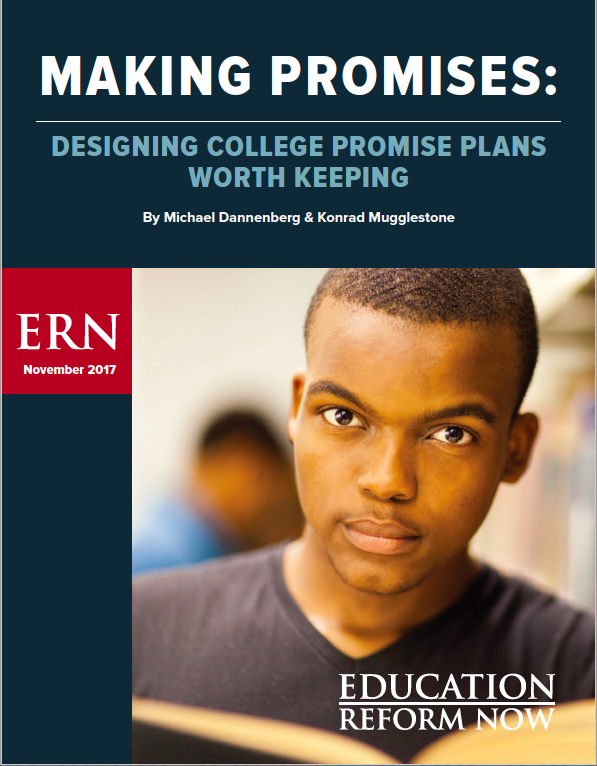
Check out the data in the latest report from Michael Dannenberg and Konrad Mugglestone here. For a slimmed down read, check out our latest article in Democracy Journal here.
Download Now

Beware the Raid on Student Aid

By Michael Dannenberg

President Trump is proposing to empty over half of the Pell Grant program’s rainy day fund at a time when the economy is relatively stable. The money is not going to boost college grant aid for students already forced to borrow too much. Instead, like all of Trump’s proposed cuts to non-defense domestic spending, student aid funds essentially would be redirected to pay for Trump’s proposed military buildup. We should find out in a few days if Congressional Republicans will be complicit in shifting Pell Grant aid in support of the military buildup or other partisan priorities.

The raid on student aid is a bigger deal for domestic policy than just another politician dipping his hand into the cookie jar. It’s a bigger deal than being emblematic of the Trump Administration’s prioritization of weapons over people in its first budget. It’s a threat around which education advocates should mobilize, but likely won’t, because the interaction between the Pell Grant program and federal budget rules are obscure and the implications delayed in time. But the consequences of emptying the Pell Grant rainy day fund are very real for families.

A little over six years ago, the Pell Grant program didn’t have a rainy day fund and confronted a $5 billion deficit—12 percent of total program cost at the time. Because of a unique “balanced budget” rule particular to the Pell Grant program, Congress cut education spending outside of the traditional Pell Grant program to reconcile the numbers. We don’t have so-called summer Pell Grants for undergraduates anymore, because of past tiny or non-existent Pell Grant rainy day funds. We don’t subsidize education loans for graduate students during their repayment grace period any longer, because of non-existent rainy day funds.

The Trump Administration would have Congress set up a scenario where, once again, there’s a Pell Grant program funding crisis—this time manufactured—that leads to other domestic discretionary program cuts.  Click below for details on how.

http://democracyjournal.org/briefing-book/the-quiet-raid-on-student-aid/

The plan is reckless, spectacularly devious, or like much of the Trump-Congressional Republican agenda, both.

DFER DC’s Testimony at Budget Oversight Hearing for the Deputy Mayor for Education

Catharine Bellinger – Democrats for Education Reform
Testimony at Budget Oversight Hearing for the Deputy Mayor for Education

April 25, 2017

Good morning, Chairman Grosso and members of the Education Committee. My name is Catharine Bellinger and I serve as the D.C. Director for Democrats for Education Reform. I am here today to urge the Council to fully fund our schools by increasing the per-pupil funding by 3.5% this year.

We are at an exciting moment for public education in the District. From 2008 to 2015, enrollment in public schools has risen by 14,000 students. City leaders should look at this enrollment growth positively — as a sign that more families are confident in our public schools. We can only maintain this progress by continuing to provide adequate funds to our public schools.

Unfortunately, Mayor Bowser’s proposed budget for this fiscal year only proposes a 1.5% increase in the per-pupil funding level for our public schools. This proposal sets the Uniform Per Student Funding Formula at a level below the expected rise of inflation and does not keep pace with the rising costs for schools.

Insufficient funding poses a major challenge for schools in the coming school year. Our public school budgets are increasingly squeezed by rising personnel costs — salaries, and in particular benefits like health care. These costs are rising at a rate far exceeding 1.5%. Without a substantive increase to per-pupil funds, schools will be forced to choose between fair pay and benefits for teachers and important offerings like supports for at-risk students and art, music, and extracurriculars.

I urge the D.C. Council to remedy this gap in funding. In January, the Uniform Per Student Funding Formula working group convened by OSSE recommended a 3.5% increase to the per-pupil funding level. A 3.5% increase would fully fund our schools, keeping pace with rising costs and with inflation, and ensuring that all students have access to the resources they need. School finance experts, educators, parents, and constituents agree.

There is certainly room for excitement about the Mayor’s proposed budget. We thank Mayor Bowser for increasing the facilities allotment for public charter schools by 2.2% annually for four years. With this four-year commitment, schools can now make needed improvements to their buildings or lease facilities that are more sufficient for the size of their student bodies. We thank the Mayor for making a long-term investment that will provide tens of thousands of students with better learning environments.

But a place to learn is not enough — it’s what happens inside the building that leads to better outcomes for our kids. Students in all our public schools deserve schools where we can afford to attract and retain great teachers, reduce turnover, provide necessary in-school supports such as tutoring and counseling, and offer the activities like art, music, and extracurriculars that help make school a joyful place for kids to learn. I urge the DC Council to follow the recommendations of the OSSE working group and increase per-pupil funding by 3.5% so that our public schools can rise to these challenges.

Thank you Chairman Grosso and members of the Education Committee for your time, and for your commitment to high-quality public education for all students in the District.

Fix the Formula CT Calls For New Formula to Fund All Connecticut Students

fix forumla ct

DEMOCRAT BILL DYSON AND REPUBLICAN JOHN MCKINNEY LAUNCH EDUCATION GROUP CALLING FOR A NEW FORMULA TO FUND ALL CONNECTICUT STUDENTS

– Advocating for a new funding formula to support every child in the state, regardless of where they live

– Key to developing skilled and prepared workforce and supporting students with learning needs

HARTFORD, Conn. (March 13, 2017)Fix the Formula CT, a bipartisan group of Connecticut residents, today launched a campaign to address how the state funds students and schools to ensure it supports every child in the state, regardless of where they live.

With the support of former elected officials Democrat Bill Dyson and Republican John McKinney, Fix the Formula CT is building a diverse coalition of Connecticut leaders to advocate in favor of a single, inclusive funding formula that provides state funding based on precise student need.

“Education is economic development. Our schools create the skilled and prepared workers of tomorrow, which is essential for keeping jobs in Connecticut and attracting new businesses to the state,” said Fix the Formula co-chairs Bill Dyson and John McKinney in a joint statement. “Moreover, the state’s budgetary climate requires a funding system that helps not hurts the state.”

“As Connecticut works to right its fiscal ship, addressing how we fund public education is essential to improving the accountability, transparency and productivity of our state. The time to act is now.”

Mr. Dyson is a former State Representative and Chair of the Appropriations Committee, while Mr. McKinney is the former Senate Republican Leader who sought his party’s nomination for Governor in 2014.

In Connecticut, the amount of funding a city or town receives per child varies widely not only from one zip code to the next, but even at schools within the same district. Many schools lack the resources they need to provide their students with quality educational opportunities.

“We should never delay the resources our children require to succeed,” said Amy Dowell, Executive Director of Fix the Formula CT and Education Reform Now. “Our children and communities count on a funding formula that is predictable and ensures schools receive state funds on schedule every year. We see the conditions in the legislature to make this promise a reality.”

Fix the Formula CT proposes implementing a formula that includes 1) Core Student Funding: a base instructional amount for all students; 2) Student-Weighted Supplemental Funding: additional funding for students who require greater resources to learn and thrive in school, including students living in poverty, English Language Learners, special education students and gifted and talented students; 3) Equitable Division of Local-State Funding: a reasonable division of education costs between local and state resources based on a community’s ability to fund its schools; and 4) Effective and Timely Implementation: a commitment to fully funding a single formula and an implementation schedule to grant this funding.

Fix the Formula CT is a bipartisan advocacy campaign sponsored by Education Reform Now, a non-profit 501c3 organization. To learn more, please visit Fix the Formula’s website at www.FixtheFormulaCT.com, Facebook at www.facebook.com/fixtheformulact, or Twitter at www.twitter.com/fixtheformulact.

###

Amy Dowell Executive Director, Fix the Formula CT
amy@edreformnow.org
(917) 288-7929

You can also download the release, here.

The Many Trump Universities

By Steven Isaacson

Donald Trump has been making front page news again, this time for Trump University amid comments from former instructors and students describing the institution as “a fraudulent scheme” and “a total lie.”

We ought not get caught up in the idea of Trump “University” being an actual institution of higher learning, however. It granted no degrees, held no accreditation, and received no direct taxpayer money. It was simply your standard get-rich-quick business scheme.

Surprising parallels do exist, however, between Trump’s venture and actual colleges and universities that do grant degrees, do hold accreditation, and do receive substantial taxpayer support.

For years, degree and certificate granting, accredited for-profit colleges that get billions in federal funds have used many of the same recruiting tactics, organizational structures, and sales pitches as Trump University. In fact, many proprietary schools exploit the same low-income people – bottom feeding off of the hopes and dreams of folks who find themselves in dire financial situations. See the video below for examples.

And just like Trump University, the results at most for-profit colleges have been disastrous. A study released just this week revealed that associate’s and bachelor’s degree-seeking students attending for-profit colleges like the University of Phoenix, “…experience a decline in earnings after attendance.”

You might think it’s the “profit” part of Trump University and the for-profit education business model that’s the problem. Whereas not-for-profit schools are theoretically liable to those they serve, for-profit institutions are accountable to shareholders. Profit comes before education in their eyes.

Guess what, though? Non-profit colleges are not always so great.

According to a recent report by Third Way, the average private non-profit college graduates only 55 percent of freshmen within a six-year period. On average, only 63 percent of students with federal loans earned more than the average high school graduate without a college degree six years after starting.

We see similar stories with colleges in the public sector. Consider Ohio University-Southern, for example, that has only a 12 percent graduation rate– again measured six years from initial enrollment, not four. In fact, there are over two dozen other public colleges and universities that have six-year graduation rates below 20 percent.

Obama’s legacy on this issue is clear.

The most lasting aspect of President Obama’s higher education agenda just might prove to be heightened examination of college and student outcomes in addition to work on traditional access and affordability issues. At the forefront of Obama’s college quality efforts were his executive actions to ensure minimal standards for post-secondary vocational programs.

Based on his initiatives, including language that clearly defined “gainful employment,” spending on instructional services instead of marketing, sales, and raw profit at for-profit colleges is up 25 percent. Degree completion rates at four-year for-profit colleges are up nearly 40 percent.

By and large, all colleges – whether they are for-profit, non-profit, or even public – need federal funds in to survive. But they shouldn’t get a blank check from the federal government to take in students, add to the already growing amount of national student debt in this country, and then not be held accountable for failing to provide their students with meaningful opportunities to make a living post-enrollment.

So here’s our challenge for the next President:

Minimum quality standards for institutions of higher education should be set in exchange for access to federal funds. Give colleges time and help to improve first, but improve they must. A 12 percent graduation rate, or put another way, an 88% dropout rate year after year with no improvement is not acceptable.

Scams like Trump University exist in our real higher education system as well. And like Trump University, many colleges have faced or eventually will face an existential crisis.

Steven Isaacson is a Research and Communications intern with Education Reform Now.

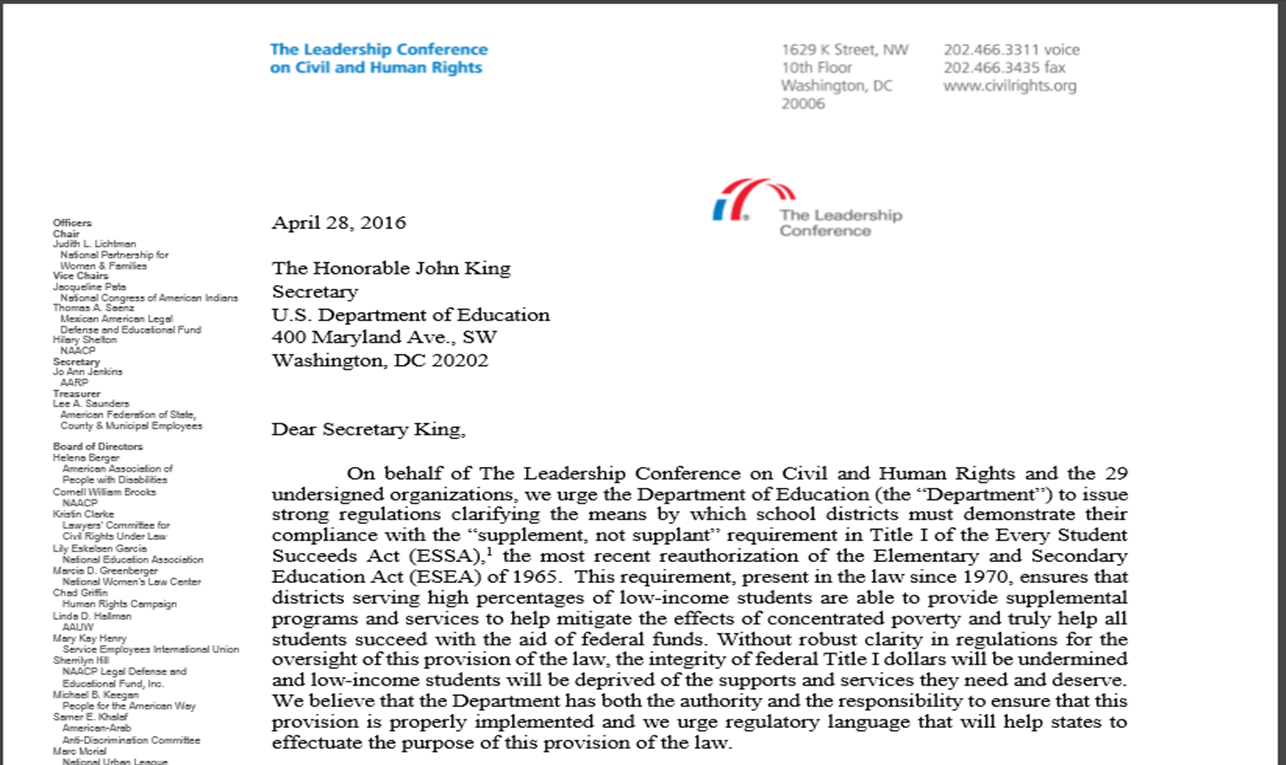
DFER Joins Letter to Secretary John King: Enforce ESSA’s Supplement Not Supplant Requirement

By Charles Barone

It wasn’t long ago that states like Mississippi admitted that Title I funding was used to build and equip cafeterias and libraries, to hire teachers, and to provide instructional materials and books to Black students that had long been available to White students. This is known in technical terms as “supplanting,” which, albeit less blatantly, many states and districts still do due to weak regulatory oversight. Read the letter we co-signed today with the Leadership Conference on Civil and Human Rights, the NAACP, NCLR, and others urging USDOE, once and for all, to end this shell game and enforce the law’s requirement that Title I funds supplement, not supplant, state and local resources intended for low-income and minority students.

Read letter here.

SNS Letter Image

our newsletter.