A Parent’s Heartbreak to See College Dreams Crushed

By Marianne Lombardo

There’s no heartbreak worse than seeing your child struggle. And when they struggle to make a successful college transition, it can impact the rest of their life. In my son’s case, the public K-12 schools and the college of his dreams got paid, but he got a pink slip.
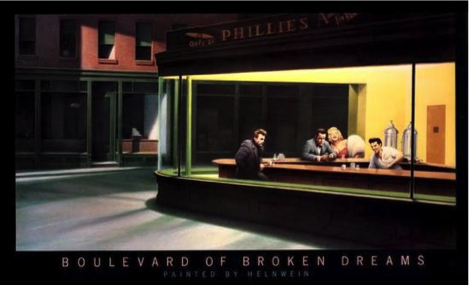
Blvd Broken Dreams

Like all parents, I wanted my kids to achieve success in life. I very purposefully moved us to one of the highest-performing (and very expensive, greatly stretching our middle-class income) suburban districts in the state to assure they would get a good education.

My son’s school experience was generally good. He got mostly good grades and easily passed the Ohio Graduation Test the first time without any issues (attaining a $500 college stipend the state provided). We found a public four-year college with a program that perfectly matched his interests and felt great that we did all we were supposed to do to launch him toward the career of his dreams.

But, it all crashed down. He only attended one quarter. He left because, surprisingly, he was not prepared for the academic demands of college. It was a surprise because it had never been pointed out by his suburban high school that his writing skills were not up to college readiness standards. That surprise deficit did him in.

struggling student
 

The program my son wanted to enroll in at college required students to attain an “A” or “B” in a required introductory course taken during the first quarter. But because of his apparent poor writing skills, he got a “C.” Crushed that he would not be able to attain a degree in the field he had chosen, he dropped out.

My son moved back home with me and enrolled in community college, where he was placed not only in a remedial writing course, but also in a remedial math course. We paid thousands for these courses, to help him relearn what he should have learned in high school, and all the while none of it counted toward a degree. He attended community college on and off for another year and a half before eventually dropping out due to work opportunities and not seeing a clear path toward how college would add value in a career field. He has never finished a college degree and is still paying back student loans.

Our story closely matches data found by my colleagues, Mary Nguyen Barry and Michael Dannenberg, in their report Out of Pocket: The High Cost of Inadequate High Schools and High School Achievement on College Affordability.”

It really hurts to see your kid not be able to attain his dream.

I feel as if our public education system failed him – both the highly acclaimed “public-private” district (where you can’t attend unless you can afford the $300K housing cost) that didn’t adequately prepare him, and the publicly-funded State University that whiplashes kids that didn’t get an adequate preparation from their high school.

I’m not saying kids should get a free pass, but our education system should be doing everything possible to help kids find success. In our experience, there was a complete lack of alignment between what we were told by the district (get good grades), what we were told by the state (pass the Ohio Graduation Test), and the reality that he did not have college readiness skills. The kicker is that once he graduated high school, the problem was ours alone: there was no responsibility or ownership on the part of the district, the state, or the college. We paid the additional price.

Our state has since increased the rigor of its state assessments, and there’s much more opportunity to get ongoing, honest, and objective feedback on how your child is doing based on these assessments every year they are tested. I hope parents understand the value of this information and use it to help if their own child needs intervention before they are cut loose from the K-12 system.

If we had better information, and if the high school had been required to provide intervention for kids that needed shoring up before they left for college, perhaps we would have been left with more than financial costs and a lifetime of wishes for what could have been.
DC Students and DC TAG Lack Meaningful College Options

By Mary Nguyen Barry

Students and families in Washington, D.C. are stuck between a rock and a hard place.

As in many cities, DC students face a number of education realities specific to an urban public school environment: segregated schools, inequitable facilities, and inequitable school resources.

But unlike most students who successfully navigate the system to high school graduation, students in Washington, D.C. face a challenge unique to the nation’s capital: they have essentially zero “in-state” public college options. All four-year college options are effectively private.

The lack of meaningful in-state public college options is one of the biggest policy issues facing D.C. high school students, said Jessica Cunningham, the principal at KIPP DC College Preparatory in Northeast.

Now technically, students do have options. They can either attend the University of the District of Columbia (UDC) or they can attend a public college out of state and receive a discount provided by the D.C. Tuition Assistance Grant Program (DC TAG).

But let’s be real.  Only 6 percent of students graduate from UDC within four years. And the discount provided by DC TAG – a program designed to give D.C. students in-state rates at colleges outside the District – is no longer achieving its goal.

Congress created the DC TAG program in 1999 to expand college choices for D.C. residents.  Recognizing the unique challenges faced by the lack of D.C. statehood, Congress provided annual grants of up to $10,000 to cover the difference between in-state and out-of-state tuition at public four-year colleges and universities nationwide (and up to $2,500 per year for public community colleges).

dc tag license

Presumably when the law was originally passed, $10,000 was more than enough to cover the in-state vs. out-of-state difference. But as states have cut financial support of their public colleges and universities in recent years, colleges have jacked up both their in-state and even more so out-of-state tuition rates to compensate. The impact on D.C. students is that their $10,000 voucher is no longer enough to meet the difference in tuition prices. So just as Pell Grants have failed to keep pace with rising college prices, so have the DC TAG grants. And ergo, DC students have another barrier – specifically tied to where they live – to college affordability and completion.

What should one do? A few options are possible:

  1. Congress could raise the maximum DC TAG amount above $10,000 so the program fulfills its initial goal of providing DC students in-state tuition;
  1. Congress could raise the maximum DC TAG amount and implement additional minimum college quality provisions to fulfill the broader goal of providing DC students with a meaningful in-state public school option; or
  1. Congress could implement our Tough Love proposal whereby nonprofit (public and private) college dropout factories like UDC receive extra financial support and assistance to improve graduation rates. But if improvement doesn’t occur after a specified period of time, they lose access to federal financial aid and tax benefits.

Option 1 adheres most closely to the original goal for DC TAG. However, it functions as an inefficient stop-gap measure if college tuition continues to rise.  In that sense, it would operate similar to the Pell Grant program that continually fails to keep up with rising college prices. It also misses an opportunity to attack the broader problem that Cunningham noted – the lack of meaningful public options for DC residents.

Option 2 would help boost DC TAG’s purchasing power but also raise the bar on what makes a college eligible for DC TAG funds.  Currently all public colleges across the United States are eligible to receive DC TAG funds (a smaller $2,500/year grant to private HBCUs and private colleges in the DC Metropolitan area is also available). But that doesn’t have to be the case. DC TAG could implement minimum institutional eligibility requirements – say only public colleges that fall in the top 95 percent of colleges nationwide in graduation rates or student loan repayment rates may receive DC TAG dollars.

Option 3, in combination with Option 2, would further heighten resources and consequences for low-performing colleges.  Let’s help UDC and other college dropout factories improve to become a meaningful option for students instead of a provider most likely to leave them in a worse financial position than had they not enrolled in the first place.

DC residents should not tolerate the fact that the only honest-to-goodness four-year public college within city boundaries has a 6 percent four-year graduation rate.

A meaningful public college option for DC residents and others requires improving the city’s current university and expanding the application of that definition nationwide.

Is the city and Congress, including Congresswoman Eleanor Holmes Norton (D-DC), tough enough to do it? Or will they continue to shortchange deserving DC students from meaningful college opportunities?

Where Does Bernie Sanders Stand on Public Charter Schools?

By Marianne Lombardo

Where does Bernie Sanders stand on public charter schools? While he’s typically a straight-talker, it’s a little hard to figure out.

On Tuesday’s Tom Joyner Morning Show, Roland Martin asked Sanders:

What do you think about charters and vouchers, which Black parents are extremely supportive of – almost 80%?”

Sanders responded: “If they are private institutions, I do not support, because they are undermining public education in general. If they are in the context of public education, I do support it.”

Martin: “So you support public charter schools?”

Sanders: “Yes. But not private.

Was Sanders saying that he thinks some charter schools are not public schools (for the record, all charter schools are public schools)? Or was Sanders making it a point to distinguish between public and private because Martin’s question also included vouchers?

Sanders’ historical record is not much help answering those questions. He’s vacillated between strong support for public charter schools and what seems like opposition to charter schools based on a mischaracterization of their being private, not public schools.

1998: Long before he ran for President, Bernie not only voted for the Charter School Expansion Act of 1998; he also entered pro-charter testimony in the Congressional Record from a ninth-grade student who said:

While I am fortunate that my family has been able to send me to private school, it should not be only the economically elite who have access to alternative education. I think a solution to this problem is federal legislation encouraging states to institute charter schools. Options would then open up for disadvantaged students. Because charter schools are still technically public schools, any student could go to the school of their choice. Students, like adults, need options; no school fits all students, just like no company is right for all workers.

Note that even this 9th grade student knew the distinction between a private school and a public charter school.

After he launched his Presidential bid, however, Sanders seems to have flipped.

October 2015: Speaking before the Massachusetts Teachers Association, Sanders seemed to accept the notion that charter schools are private schools. When asked:

You mentioned the need to stop privatizing public education. One way to stop that is to make sure that there is a very strong, very reasonable cap on charter schools. I come from a district … where students are leaving in droves to attend these sort-of “miracle” buildings that are the charter schools – and as a result we’re losing valuable funding in already strained budgets. I would hope that in your campaign that you would continue to strive to keep public funding in public schools.”

Bernie responded: “absolutely.

January 2016: At a Town Hall in Newmarket, New Hampshire, Sanders again seemed to imply that he considered charter schools as private schools stating:

I’m not in favor of privately run charter schools. If we are going to have a strong democracy and be competitive globally, we need the best-educated people in the world. I believe in public education.

Does Sanders, unlike the 9th grader whose testimony Sanders inserted in the Congressional Record, not know that charter schools are public schools? Is he misinformed about the fact that all public charter schools are created under public law as part of the public education system, a system that has all kinds of schools e.g., open enrollment, selective admission, magnet, special needs? Is he not aware that public charter schools, unlike private schools, have to accept all students, can’t charge tuition, and are non-sectarian?

Or is Sanders trying to imply that he only considers public charter schools authorized by local districts as part of the public education system, but not those authorized by the state or other agencies empowered by state government to do so? The problem with this is that it would exclude those public charter schools run by non-profit management companies, such as KIPP, YES Prep, GreenDot, and Democracy Prep. Moreover where, in Sanders’ view of the world, would public charter schools not overseen by districts but run by independent groups of teachers, parents and/or community members – the largest group of charter schools – fall?

Bernie’s got a great reputation for speaking plainly. It would be really helpful if he tasked his staff with giving him all the facts about public charter schools and provided clarity to voters on where he stands.

Trump: And Liberty for Some

By DFER

The parade of pandering Republican candidates for President continues Monday (MLK Jr. Day) when Donald Trump becomes the latest to visit the evangelical hub known as Liberty University.

These days, most non-right wingers know of Liberty University as the college where – in the wake of the San Bernardino mass shooting – school president Jerry Falwell, Jr. called on students to obtain and carry their own guns on campus.

“Let’s teach them a lesson if they ever show up here,” Falwell told students on Dec. 4th while referencing a Glock pistol in his back pocket, according to the Washington Post’s Nick Anderson.

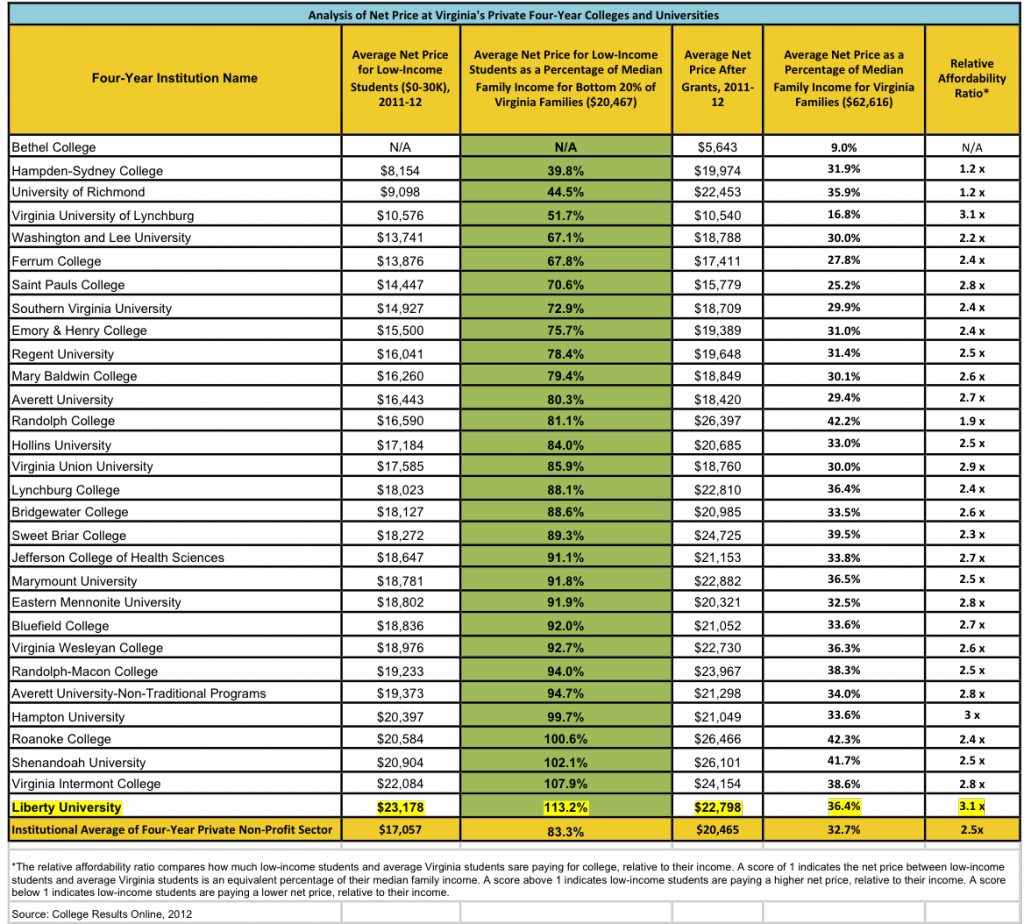
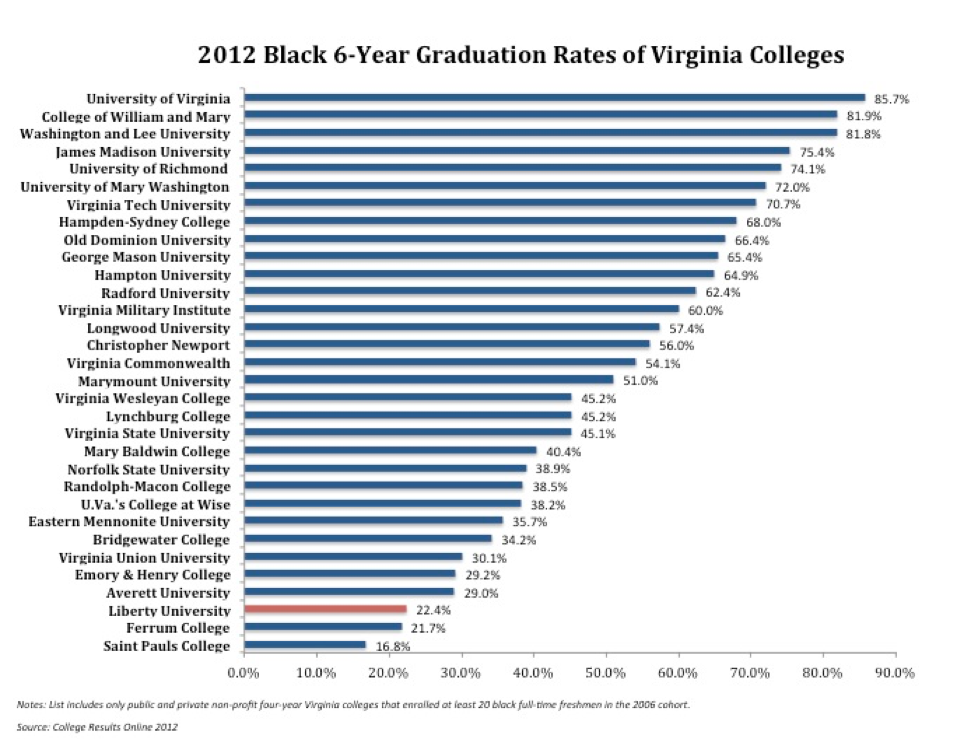
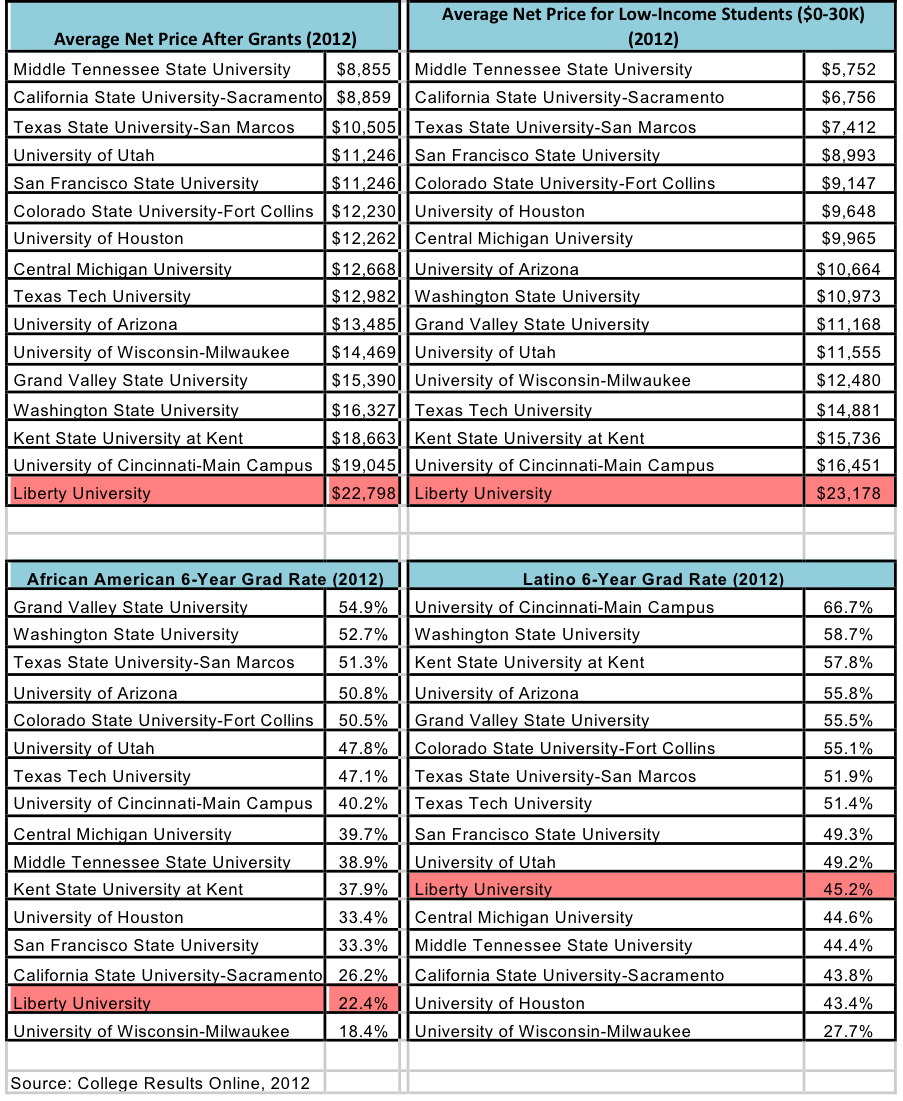
Now when we think of Liberty University, our thoughts focus on, well, education.  Liberty University is one of the worst colleges in America for poor and minority students.  It has high price, high debt, and deplorable black student completion rates as compared to peer institutions serving similar students.  Here are the numbers, according to university-submitted data to the U.S. Department of Education. 
High Price & High Debt

Graduation Rates for Black Students

High Price & Low Graduation Rates for Minority Students at Liberty University
As Compared to Peer Colleges Serving Similar Students

We don’t expect Donald Trump will say anything about Liberty University’s record with minority and low-income students.  But someone should.  In fact, civil rights accountability hawks should go further and demand Liberty take action or lose some of its very generous federal aid. With liberty comes responsibility.

Highlights from Education Week’s 2016 Quality Counts Report

By Marianne Lombardo

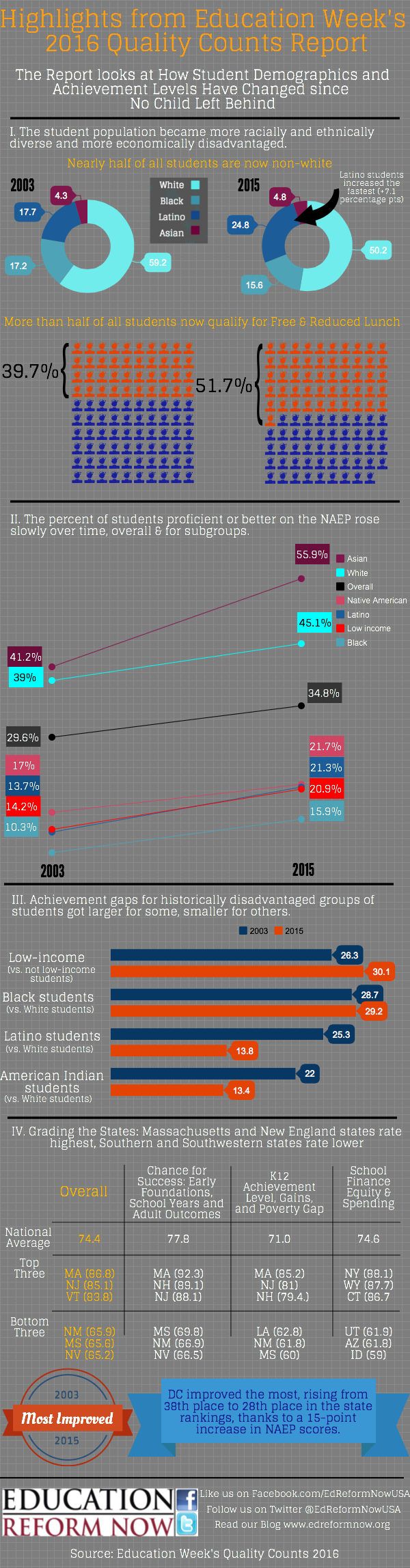
Education Week’s annual Quality Counts Report explores different themes throughout the years – such as standards, teaching, early childhood, special education, finance, globalization, and discipline.

The 20th edition, Quality Counts 2016, “Called to Account: New Directions in School Accountability”, takes a deep look at education accountability, an extremely important topic as the nation transitions to new accountability systems under the Every Student Succeeds Act.

The report:

  • Examines changes in student demographics and achievement since 2003.
  • Grades the states by computing a Chance-for-Success Index, a K-12 Achievement Index, and a school finance analysis for each state, and
  • Explores changes in accountability systems we’ll see with the new federal law, where having good data to compare states will be more important than ever.

In a nutshell:

  • The student population became more racially and ethnically diverse and more economically disadvantaged;
  • Achievement levels for all demographic groups rose slowly over time;
  • Achievement gaps between low-income students and their more advantaged peers increased slightly (about 4 percentage points);
  • Achievement gaps between black students and their white peers stayed roughly the same;
  • Achievement gaps between American Indian and Latino students, and their White, non-Hispanic peers decreased by roughly 50%;
  • Massachusetts and other Northeastern states rank high, whereas southern and southwestern states tend to rate lower; and
  • DC improved more than any of the 50 states.

2016 Quality Counts

RELEASE: Poll Shows DC Parents Want Expanded High-Quality Educational Options

FOR IMMEDIATE RELEASE

Poll of DC Voters Shows Parents Want to Expand High-Quality Educational Options in DC

Poll finds support for expansion of high-performing schools in vacant buildings and cross-sector partnerships to turn around under-performing schools

Washington, DC – Today, Education Reform Now’s DC Chapter released the results of a survey of registered voters in Washington, DC, regarding attitudes toward public education in the city. Conducted by the Benenson Strategy Group, the survey found that while voters see improvement in the quality of public schools, they also view that progress as lopsided, with more significant progress in higher-income neighborhoods. Voters believe city leaders must act now to address these inequities to ensure fair access to educational opportunity for all public school students. They overwhelmingly support allowing successful schools, both district and charter, to expand in vacant school buildings in order to reduce waiting lists at the most popular schools and expand the number of high-quality seats available in the city.

“These poll results could not be more clear. Eight years after the reforms enacted under mayoral control, DC voters feel that we have made significant improvements to the quality of the city’s schools. We’re going in the right direction — but there is still more work to be done, particularly in low-income neighborhoods, to ensure fair access to quality schools. Voters also know that if we are going to keep young families in the District, we have to make sure children in every neighborhood can attend a high-quality public school. We must accelerate what’s working to improve the quality of traditional schools, and we need to reduce waiting lists and crowded classrooms by opening more top-performing public charter schools,” said Catharine Bellinger, Director of Education Reform Now’s DC Chapter.

“The 12 vacant former school buildings in DC – which represent a total of nearly 1.4 million square feet–provide the perfect opportunity to expand high-quality options for our families. Rather than letting taxpayers foot the bill while unused buildings become increasingly dilapidated and vandalized, let’s accelerate the release of more of these buildings to our highest-performing and most popular public charter schools.”

Conservative estimates project that DC’s population of public school students will grow to 125,000 by 2025. That means that within the next ten years, DC will need to serve an additional 40,000 children in DCPS and public charter schools. The poll findings show that DC parents want to invest now to improve DC schools, particularly by increasing capacity in the most popular schools, so that every child can access a high-quality education.

Some key numbers from the poll include:

  • 7 in 10 voters agree (including 75% of parents) that “schools are improving in upper-income areas of DC, but schools in lower-income parts of the District are being neglected.”
  • 76% of voters, including 83% of parents, agree that “in order to keep young families in DC, we need to improve the quality of traditional DCPS schools, but we also need to expand the top-performing public charter schools so more parents can choose a school that is right for their child.”
  • 3 in 4 voters (76%) believe public charter schools should be part of the solution for vacant school buildings.
  • 2 in 3 voters (65%) support a proposal for DCPS to partner with a “top-performing public charter school” to help turn around struggling schools.

The poll was conducted by Benenson Strategy Group from September 28-October 6, 2015, and includes data from 686 telephone interviews. All respondents are registered voters in Washington, DC, and an oversample of parents and cell phone users was included to ensure accurate representation in the survey. The margin of error for the data set is +/- 3.7% at the 95% confidence level. The margin of error for parents is +/- 5.9% at the 95% confidence level.

The full polling memo can be found here.

###

Contact:
Catharine Bellinger
202-361-9172

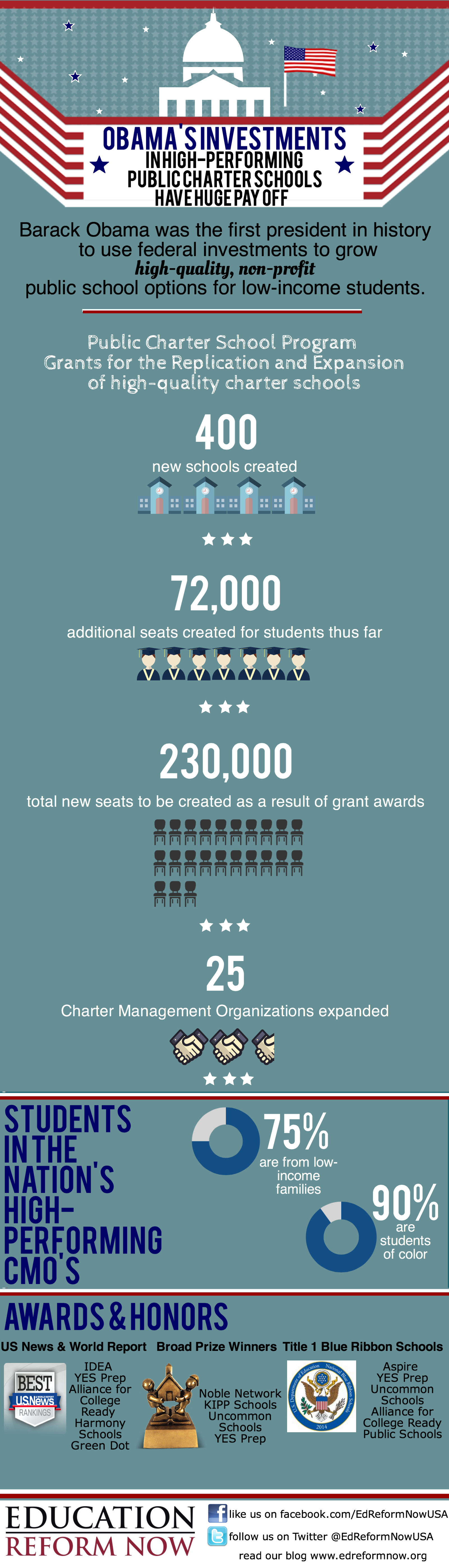
Obama’s Investments in High-Performing Public Charter Schools Have Huge Payoff

By Charles Barone and Marianne Lombardo

Today, Secretary of Education Arne Duncan will announce annual federal Charter Schools Program grants to states and non-profit charter management organizations. This round of grants marks a new milestone in President Obama’s education reform legacy. What distinguishes Obama from his predecessors, and what makes him a true champion of our nation’s schoolchildren, is his coupling of new investments in public school choice with a laser-like focus on high-performance, especially for poor and minority students. This Administration has invested a small but significant amount of funding in the replication and expansion of charter school management organizations that have a proven track record of high performance – something no other President has done. Here is a brief rundown on the beneficial impact of this initiative.

obama csp 2 18pt Copy_mnb-2

Tough Love on Student Loan Repayment Rates

By Mary Nguyen Barry

When my colleague and I wrote our Tough Love report last year, we recommended the federal government draw a line at the bottom 5 percent of four-year institutions in terms of their performance in carrying out the core purposes underlying federal student aid: low-income student access, student graduation, and student loan repayment.

The bottom 5 percent of colleges would then be given a dose of Tough Love. Either improve over a set period of time – to show they could still provide students and taxpayers with some minimal value – or eventually lose access to various forms of federal financial aid. Under-resourced colleges, such as many minority-serving institutions, should receive additional financial and technical assistance before any consequences attach.

At the time, student loan repayment rate data was not available to calculate a bottom 5 percent benchmark so we took a look at very suboptimal cohort default rate data. But now, loan repayment data by institution is available thanks to the newly released College Scorecard. Now, we are finally able to identify the country’s lowest four-year college performers in terms of return on investment: colleges where more than 62 percent of former students cannot pay down any principal on their student loans. In other words, these are colleges where 62 percent of students who borrowed to enroll end up in a much worse financial situation than when they first enrolled.

Loan repayment rate data is crucial to our full understanding of problems facing our higher education system; it can pinpoint colleges that not only have degree production issues but also quality degree production issues, as measured by students’ ability to make progress on paying down their student debt.

Yet our federal accountability system – to the extent there is one – is still based on an antiquated measure of cohort default rates that only captures the worst possible outcome among student loan borrowers: those who cannot make a student loan payment for 9 consecutive months. Colleges with a default rate above 30 percent for three consecutive years or 40 percent in any one year can lose access to federal student aid. What’s more is that we know default rates are easily gamed – colleges have been documented to push students into deferment or forbearance so that they will not show up in the default calculation. Only about 20 schools have been subject to sanctions from the most recent cohort default rate standard.

Currently, there is a bipartisan bill to replace our federal accountability system based on default rates with one based on student loan repayment rates. Called the Student Protection and Success Act, it was co-sponsored by Senators Jeanne Shaheen (D-NH) and Orrin Hatch (R-UT) and is currently under committee consideration. They propose that schools with repayment rates more than 10% below the national average over a three-year period lose eligibility to participate in the Title IV federal student loan system. The problem with that bill though is that it’s Tough, but it doesn’t provide much Love in terms of added support for institutions that are failing because they are grossly under-resourced.

It’s easy for politicians to be tough, and it’s easy for advocates to call for more love. It’s hard to embrace Tough Love, but it’s the right thing to do for students and taxpayers alike.

Sneak Peek at Obama’s Higher Ed Legacy (VIDEO)

By Hajar Ahmed

As Congress debates a re-write of No Child Left Behind Act this week, it’s worth noting that the same issues of inadequacy, inequity, and accountability for underperformance are also present in higher education policy.

In response, national leaders confront the same basic 30,000 feet-high political question: Are you for simply more resources OR reform?  Or are you for more resources AND reform?

How did President Obama answer the question and what were the results?  You might be surprised at the magnitude of the answer, the successes, and the failures.

Check out a sneak peek of our report on the Obama higher ed legacy and the 2016 campaign.

our newsletter.