DFER Election Day Results

As many of us expected, the results from Tuesday’s Election are not quite final yet—with the last of the mail-in ballots still waiting to be counted—but as of this writing, Vice President Biden has pulled ahead in crucial states.

While Trump and his team may try to undermine the process and invalidate results, it is basic in a democracy that every one of these votes must be counted, and so we must remain patient, vigilant, and hopeful as we await the final tallies.

Democrats will retain control of the U.S. House of Representatives, while the U.S. Senate remains tight, thanks to critical wins from DFER John Hickenlooper (CO) and Mark Kelly (AZ), both of whom DFER partner organization Education Reform Now Advocacy (ERNA) supported through GOTV efforts in their respective states. The ultimate control of the Senate looks to be decided in January, as two Georgia Senate races—Democrat Jon Ossoff and incumbent Republican David Perdue, and Democrat Raphael Warnock and Republican Kelly Loeffler, respectively—are likely heading to a runoff.

This election saw the highest voter turnout in more than a century. We’re proud to have helped empower hundreds of thousands of voters across this country to exercise their right to vote—including through ERNA’s GOTV efforts in Colorado, where Biden secured a victory, in Arizona, where he is still likely to win, and in Georgia, where the race has tipped in his favor, but still has not been called.

There’s also much to celebrate in our state chapters. Election night returns show significant wins across our chapters, as veteran and first-time DFERs won their races—elevating education reform advocates in all levels of government.

DFER Colorado had a big night, helping to:

  • Elect former Gov. John Hickenlooper to the U.S. Senate, flipping the state’s U.S. Senate seat in a crucial win for Democrats nationally.
  • Pass five ballot initiatives in the state, including the DPS Bond and Mill and Durango Bonds that will increase funding for Denver and Durango public schools, respectively, Proposition EE that will fund universal Pre-K, and Amendment B repealing Gallagher, which stabilizes property tax funding for schools.
  • Grow the Democratic majority in the State Senate by one seat, winning eight races with two races still too close to call.
  • Maintain the majority in the State House, winning 14 races last night with 1 DFER champion’s race still too close to call.

In Connecticut, Democrats gained ground in both chambers of the legislature, with several more races undecided. The team participated in a targeted GOTV effort in multiple regions, with many of those races still too early to call.

In DC, Jacque Patterson, a founding DFER DC Board Member and chief community engagement and growth officer for KIPP DC Public Schools is the Representative-Elect of the DC State Board of Education (At-Large). Another DFER DC-backed candidate, Allister Chang, won a ward-based seat on the State Board of Education.

In their efforts to maintain a supermajority on the Orleans Parish School Board, DFER Louisiana helped outright re-elect education reform champion John Brown (D1) and elect first-time candidate Olin Parker (D3). DFER-backed candidates will be heading into runoffs in four districts.

In Massachusetts, Democrats retained their super-majority in both branches of the state legislature. DFER MA support of House incumbents facing challenges, all of whom were returned to office, and support for Democratic challengers to anti-testing Republicans, continued to maintain a consistent strong baseline of electoral support for reform.

Votes in the majority of New York races are still being counted, however both DFER NY supported Rebecca Seawright and Jeremy Cooney appear to have picked up wins in the state Assembly and Senate, respectively.

Our Washington team continues to follow several unfolding races in state, including Marilyn Strickland’s historic run for the U.S. House of Representatives to become the state’s first African American woman to represent Washington. Early in the evening Gov. Jay Inslee also secured a historic third term as Governor.

Outside of our state chapters, DFER is also proud to have supported education champion Luisa Santos, who won a seat on the Miami-Dade School Board.

We also congratulate Leaders of Color alumna Marquita Bradshaw on a hard-fought race in Tennessee. Bradshaw made history as the first Black woman to win a major party nomination for U.S. Senate in Tennessee, and while she may not have secured the Senate seat last night, we know Marquita Bradshaw will continue to be a trailblazer in her fight for equity.

While the blue wave we hoped for wasn’t present on Election Day itself, it has been slowly trickling across the map and over races ever since, through the return of hundreds of thousands of mail-in ballots.

Regardless of the final outcome, Joe Biden has officially received more votes than any other Presidential candidate in history, and the prospect of a Biden-Harris Administration, coupled with the wins in our states, gives us hope and will make a real difference in the lives of students.
Latest Polling Finds: What Matters Most to Swing State Voters

Recently our partner organization Education Reform Now Advocacy (ERNA) teamed up with HIT Strategies and Latino Decisions to conduct polling in North Carolina, Georgia, Wisconsin and Arizona. Findings showed, in all of these key swing states, Biden is maintaining a small but very real lead. Our polling also found that accountability and high quality public choice continue to be popular with voters, and specifically, there is clear support for expanded access to public charter schools. Trump’s poor performance in responding to COVID-19 has been reflected in Arizona, where many voters feel he has not done a good job of keeping students safe or providing them with the best education possible during these times.

The polls were conducted between the below dates:
North Carolina and Georgia: July 23 – 31, 2020
Arizona: Sept. 28 – Oct. 6, 2020
Wisconsin: Oct. 14-19, 2020

Biden Holds Narrow Lead
Across the four states, Biden polled ahead of Trump—though still tight in three of the four states.

NC: +10 GA: +4 AZ: +3 WI: +5

The gap widens substantially among voters of color: 83% of Black Wisconsin voters and 64% of Latino Arizonans say they support Joe Biden.

Biden Benefits from Coney Barrett’s Confirmation
When asked about Amy Coney Barrett’s, then potential, confirmation to the U.S. Supreme Court, Wisconsin voters indicated they would be more likely to support Biden by 7 percentage points, should Trump appoint a conservative judge.

This gap was even wider among registered Independent voters, who would then favor Biden over Trump by a whopping 19 percentage points. In Arizona, 42% of voters—including undecided and leaning voters by more than two to one—would be more likely to vote for the former Vice President if the Senate votes on Justice Ginsberg’s replacement.

Democrats Leading in 2 of 3 Senate Races Polled

  • In the Georgia Senate race, Democrat Jon Ossoff led Republican David Perdue 42% – 39%.
    • The Georgia Senate special election was tighter and slit between a crowded field. Republicans Kelly Loeffler (22%) and Doug Collins (18%) led Democrats Raphael Warnock (14%) and Matt Liberman (14%), though 23% of voters at the time were undecided.
  • In Arizona, voters favored Democrat Mark Kelly over Republican Martha McSally (47% to 42%).
  • In Wisconsin, 56% of voters approved of Democrat Senator Tammy Baldwin, while only half (an even 50% split among a crowded field) approve of Republican Senator Ron Johnson. Note: neither senator is up for re-election in Wisconsin.

COVID-related Education Woes Weigh Heavily on Voters
Across the country, Biden overwhelmingly is seen as the more trustworthy candidate when it comes to education.

  • In Georgia and North Carolina, 57% total voters listed distance learning as their main education-related concern going into elections, with the majority of voters (>50%) opposed to students and teachers returning to school before there is a coronavirus vaccine
  • In Arizona, 49% of Arizona voters feel Biden will do a “better job” with education, compared to 37% who believe the same of Trump
  • In Wisconsin, 58% of total voters—and 72% of Black voters—feel that President Trump has done a poor job of keeping students safe at school and providing them with the best education possible.

Voters Support Administering Annual Assessments in Spring 2021
Despite the disruption in annual assessments this year due to the Coronavirus pandemic, the majority of voters polled support administering annual assessments in Spring 2021. This includes:

  • 51% of parents surveyed in both Georgia and North Carolina; and
  • 67% of voters in Arizona.

Voters Want Public School Choice and charter schools
Voters made it clear that, when it comes to public school choice, they support expanding access to more choices, including public charter schools.

  • In Georgia and North Carolina 73% of all voters, and 69% of African American voters, and 75% of parents, indicated their favor.
  • 74% of voters in Arizona, including 77% of Latino voters, support more options within the public school system, including public charter schools.
    • 73% support expanded access to public charters with tougher accountability rules, including 76% of Latino voters.
  • In Wisconsin, 63% of respondents, including 74% of Black voters, were also in favor of expanding access to more options within the public-school system, including magnet schools, career academies, and public charter schools.

While the outcome of the upcoming election is uncertain, this polling tells us that voters in crucial states support Biden, support public school choice, support statewide annual assessments, and most certainly support equitable education.

We will keep fighting to see their wishes fulfilled.

DFER CT Playbook: Election 2020 Preview!


Who’s Voting in Connecticut?

Connecticut, solidly blue and low in electoral college heft, will not impact the outcome of next Tuesday’s presidential election like a “swing state”. That has not slowed enthusiasm, and could have significant consequences in many down ballot races. 

Connecticut has recorded an all time high in registered voters. Last night, October 27th at 11:59 PM, was Connecticut’s voter registration deadline. The state has seen a surge in registrations, making history with 2,295,644 new voters, including over 624,000 new registrants since 2016. New enrollment includes 41% unaffiliated voters, 37% Democratic, and 21% Republican registrants, and less than 1% of other parties. This number still is subject to change as Connecticut allows for Election Day Registration, commonly expected in a Presidential year. 

The newly added option of filing for an absentee ballot as a condition of COVID-19 has led 673,811 voters to request absentee ballots and nearly 500,000, or nearly 70%, of these ballots have been returned a week out from Election Day. When it comes to returning absentee ballots this year, Democrats have the advantage there as well. Roughly 28% of registered Democrats, 16% of unaffiliated voters and 14% of registered Republicans have returned their ballots as of yesterday. However, there are still nearly 80% of registered Connecticut voters who have yet to vote. 

Based on the survey our affiliate ERNA CT conducted last week, despite significant evidence that voting by mail is secure, many voters still express concerns about both the integrity of voting absentee and by mail. Only about half of all voters — 49% — say they trust the mail-in or absentee approach as much as in-person voting, while 43% say they do not. As we saw in our polling, 61% believe Connecticut should join with 44 other states by passing an early voting law.

And Who Are They Voting For?
The state’s most consequential elections are likely at the legislative level, where races will  decide the balance of power in the State House and State Senate. In the State Senate, Democrats are seeking to grow their 8 seat majority; while in the State House, Democrats are looking to grow their 31 seat majority. 

In terms of trends, we will continue to keep an eye on Fairfield County and whether Democrats could maintain momentum from 2018 which includes protecting first term Senators Alex Kasser and Will Haskell, and possibly knock off State Senator Tony Hwang in his spirited rematch with Democrat Michelle McCabe. In the House, two numbers we’ll be keeping an eye on: 11 seats that flipped in 2018 and 12 seats that Trump carried in 2016. In both chambers, we anticipate Democrats to maintain sizable majorities, but the politics of these competitive races will speak to demographic trends that have been clear over the last four election cycles in and around Fairfield County. 

In April, we released our preview of the elections; and much of the dynamics have remained the same with the exception that there were several other retirements including House Minority Leader Themis Klarides (which means three out of four caucuses are expecting to have new leadership in 2021!). During this unprecedented election year, in the midst of the COVID-19 crisis, results could point to a very different and important year in Hartford in 2021.

Now, GO VOTE!

RBG: Mourning a Legal Lion and Honoring Her Legacy

By Yarah Kassam, DFER National Deputy Development Director

The recent loss of Associate Justice Ruth Bader Ginsburg was a severe blow to the fight for gender equality and the American legal system as a whole—and her passing, and the potential consequences it may bring, only gives voters yet another reason to turn out this November, to stand against the tyranny and oppression this Administration practices. 

From her time as a law professor and litigator, Justice Ginsburg fought hard. She faced discrimination on all sides and in all of her endeavors. She was met with opposition in her education, and as she sought employment, but rather than let these barriers stop her, Justice Ginsburg pledged to change the system, so that future generations of women would not have to face the battles that she did. From fighting for equal pay as a law professor at Rutgers University, to her tenure as the first director of the ACLU Women’s Rights Project, to winning five out of the six cases she argued in front of the Supreme Court, Justice Ginsburg never gave up on the work needed to ensure that men and women would be seen as equals under the law.
In her majority opinion in United States v. Virginia, Justice Ginsburg challenged the male-only admissions policy at Virginia Military Institute, stating, “we can no longer limit women by generalizations of what they can and cannot do.” While this seems now like a standard analysis of the Constitution, this case enacted a precedent and laid the groundwork for establishing gender equality as an inherent tenent of our constitutional interpretation. In fact, many of the things we now take for granted, we only have because of the inexhaustible brilliance of the Notorious RBG. 

Throughout the nearly three decades she spent on the Court, Justice Ginsburg also became known for her fiery dissents. Even when a decision did not go the way she would have chosen, Justice Ginsburg continued to advocate for equal rights through her dissenting opinions in order to have her thoughts on record. 
Justice Ginsburg defied society and defined history. As one of the only four women to ever serve on the Supreme Court, Justice Ginsburg’s voice and legacy is more than a pawn in a fear mongering political game. 
While Republicans may hypocritically try to replace Justice Ginsburg before the American people have a chance to vote for the next President, her legal excellence and deep humanity remain irreplaceable—and her historical work will live on through inspired law students and legal minds as we continue to fight for equality and equity in this country. 

And fight we must.

If, for some reason, the loss of Justice Ginsburg isn’t enough motivation to vote, one needs only to look to the staggering number of additional tragedies this year of bigotry has wrought, including the senseless deaths of so many innocent Black men and women—and the lack of justice in the prosecution of these murders—and the passing of civil rights icon Congressman John Lewis. Amidst so much pain and unrest, we’re also living through an unprecedented pandemic, with only the “leadership” of an incompetent President for guidance.
This year has been demanding on the emotional well-being of millions of people. And when so many have lost so much, we honor them and each other by turning out in droves for this election. Our latest grief is Justice Ginsburg, a woman who dedicated her entire life to fighting for the American people. The least we can do for her in return is to show up on November 3.

Our current “leadership” is failing us, and has done so for years, but we have a chance to intervene and shift the course of our nation by voting this November. The fate of our democracy and our equality as we know it is on the brink, and we cannot let Justice Ginsburg’s decades of efforts hang in the balance. Elections matter. Your voice matters.

So vote for our future. Vote to honor all of those we’ve lost this past year. Vote for Ruth.

DFER Deep Dive: We Must Have Change – The Reality of Racism

Leaders of Color Discuss Today’s Reality of Racism and Inequity

By Dr. Damary Bonilla-Rodriguez, with Carolina Ramirez, Biena Depena, and Constance Barnes

Current race relations and community-police dynamics are finally shedding much-needed light on the struggles that communities of color have long gone through simply to exist alongside those who are entrusted with their protection. While the stories of these pains are far from new, and far from few, they’ve historically been swept aside. But for some of those who grew up in marginalized communities tasked with proving their worthiness daily, their experiences with systemic racism have only served as motivation to fight against the continual violence and historic oppression against people of color in America–the oft-ironically named Land of the Free.

“My name is Carolina Ramirez, and I am an artist and an educator. My upbringing in the inner-city education system was far from easy.  At nine years old, my father was convicted of drug charges and sentenced to 10 years in federal prison—a tragedy that inspired me to pursue a career in law. At age 13, hoping to follow my dreams and save others from the pain my family suffered, I made a decision—based on shoddy advice from a middle school counselor—to attend Washington Irving. By 14, I was traveling almost an hour to downtown Manhattan from my home in Harlem. Every morning, I’d wait in blocks-long lines, whether rain or shine, to attend classes in a Title I school—where 90% of students were from low-income families, test scores were low, and resources were scarce. The start of my day also meant walking through metal detectors, and I was also submitted to intrusive body scans–a humiliating experience endured daily merely to access an education.

But my reality is far from rare. In fact, this is the norm for most Black and Brown schools across the country—resulting from fraught relations between overpowered school safety and discipline officers and overzealous state police departments—and the students they are supposed to protect.”

By the late 1980s, New York schools—by-proxy of the state Board of Education—relinquished school safety management to the NYPD. Under these parameters, school safety personnel and school assigned officers report directly to NYPD, and are therefore not beholden to any child-focused provisions that support a student’s development. By the 1990s, New York’s schools were experiencing a crippling crisis in understanding and handling student behavior, choosing to forgo benevolence and enacting instead a zero tolerance philosophy that mandates strict and severe predetermined consequences.

These policies, coupled with over-policing are found particularly in schools predominantly populated by students of color, and are a clear indicator of the systemic issues plaguing marginalized communities, and the promotion of the school-to-prison pipeline.

“Much like Carolina, I am familiar with a difficult school experience. My name is Biena Depena, and I am an education reform activist. I remember my high school days as an immigrant attending school in the New York suburbs mostly as overcoming hardships. For four years, I walked a mile and half to school, waiting in long lines no matter the weather, only to get in and walk through invasive metal detectors—all so I could have the opportunity of an education. I recall receiving multiple detentions for being late to class, even though my tardiness was caused by security guards holding me up for further inspection—a hindrance that my affluent white peers never seemed to experience. I remember this also as my first painful realization that the policing of Black, Brown, and poor bodies was alarmingly different than the policing of wealthy white bodies.

Sadly, the experiences of Carolina and myself are not a dark historical note that we’ve learned from; rather, they’re seemingly more prevalent than ever: a plague of oppression amongst Black and Brown schools where students just want the chance to learn.

As a country, we are at a time when we must heed the call to action. It is time we diverge from the structures that have failed—and continue to fail—students and communities of color. It is time to start investing in social, economic, and political structures that empower students who have been so often marginalized and disenfranchised. It is time to build an educational system that serves as a safe space of transformative learning, social and emotional support, and development for every student.

In the last few months, I have been pondering over social media posts made by my white former colleagues. With statements like, ‘Why does it have to be about race?’ and, ‘All lives matter,’ I can’t help but assume these people have no idea how it feels to be unfairly prosecuted by the color of their skin—even when you’re an innocent and hard-working young student. I know, like Carolina and Constance know, that these people don’t know the petrifying fear Black and Brown folks experience when a police officer pulls them over, or the crippling anxiety the heats your blood as you run through all of the things you imagine you may have done to deserve it. And we know these people making these social media posts don’t understand that, many times, the only thing Black and Brown people have done to ‘deserve’ their treatment by police is exist.”

“Biena and Carolina are far from alone. I, too, am struggling with the structure of our country. My name is Constance Barnes, and, for me, reality is trying to catch my breath in order to not drown in a sea of complexity and confusion. I sit somewhere between sorrow and rage watching the lives of Black men needlessly sacrificed in real time, thanks to social media. There are so many scenes of protests, where it’s sometimes hard to discern who is actively marching for the cause, who has been so incensed that they are moved to violence, and who has infiltrated the greater good for their own personal agenda.

I am the granddaughter of southern sharecroppers, and I can clearly recall my mother’s tales of racism and segregation growing up in a rural Alabama town. My father, born and raised in New York, had brushes with the law as a teenager and dropped out of school by ninth grade; and I am keenly aware of the fact that one third of all Black men will have an encounter with the penal system in their lifetime—a statistic perpetuated by the school-to-prison pipeline—because this statistic has ravaged its truth amongst my immediate family.

Our experiences aren’t isolated. Rather, they are the collective history of Black and Brown folks across the country. We are all  of us every day inundated and oversaturated with imagery reminding us of the systemic and systematic racism that has prevailed in our country since its origin. Yet, despite being stripped of our native inheritances, communities of color haven’t sought hand-outs. Instead, we have simply sought acknowledgement as equal, living, breathing human beings. We aren’t asking for favoritism in justice, education, or provision of health, nor preferential treatment in housing or transportation matters—we’re merely asking for equity.”

The feelings of fear described by these women permeate so many of our realities. Coupled with the structural displays of inequity, further compounded by negative police relations dynamics in our schools and communities, it’s no wonder that people of color are hindered from living the free life promised by the U.S. Constitution, and enjoyed by so many white citizens.

Indian ethicist Mahatma Gandhi once said that “You must be the change you wish to see in the world,” and, my friends, we must.

We can no longer sit idly by and wait for change. Each person has a responsibility to actively engage in positive changes for their community and society. I implore each of you to consider how you can be civically engaged through opportunities such as formal and informal education, voter registration, outreach and engagement efforts, community and school board processes, supporting political candidates and organizations whose values resonate with yours, running for elected office, and being involved in your child’s PTO, and more.

At Leaders of Color New York, we’re doing our part to look at this moment as a springboard for growth. We strive to raise the voices and elevate the experiences of Black and Brown leaders—like Carolina, Biena, and Constance—by providing a suite of resources to help these leaders run for elections and increase their positive influence. While community-based leaders are uniquely positioned to understand the need for education reform, local leaders who support reform values are also the least likely to receive the supportive services they need.

Leaders of Color seeks to bridge this gap with our training program that unapologetically seeks to usher in a new, bold group of Black and Latino elected officials.

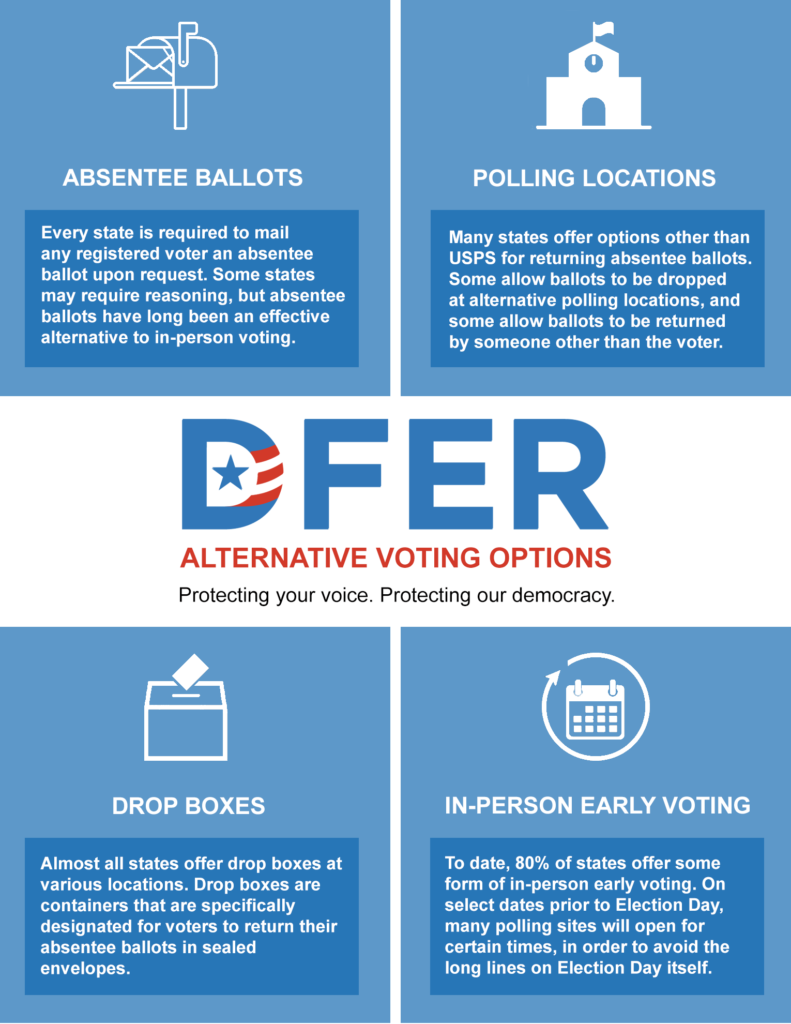
Making Your Voice Count: Alternative Voting Options

This November presents the most important election in memory—all while a pandemic continues to rage across our country, and as the Trump Administration is doing everything in its power to silence voters in an undemocratic act of desperation fueled by a dangerous need to retain power.

But we do not have to be suppressed. Each of us can still be heard, and if we choose to stay home on Election Day for our own health or safety reasons, we can still vote safely and ensure our voice counts.

Below, please find safe alternative options to voting in person on Election Day.

  • [faq p=11313]
  • [faq p=11314]
  • [faq p=11315]
  • [faq p=11316]

Regardless of whether you decide to mail in your absentee ballot, take it to your local polling place, or a designated drop off box, election officials must receive all ballots by the time polls close on Election Day—Tuesday, Nov. 3. If you decide to brave the lines on Election Day, please remember to locate your correct polling place, maintain your distance as much as possible, and above all—MASK UP!

Let’s make sure ALL voices are heard, safely.

Trump is No Friend to Public Ed

Let’s be clear: Donald Trump has been no friend to public education—including public school choice—and he certainly has not been an advocate for racial justice.

Trump and DeVos have long supported the privatization of schooling, rather than making an investment in public education.

As DFER Vice President of K-12 Education Charles Barone has previously detailed—there’s mounting evidence for Trump and DeVos’ interest in private over public education. Instead of bringing quality education to Detroit, Charles notes that, “DeVos supported a charter school sector based on private, for-profit, fly-by-night operators that was an out-and-out disaster for Motor City students and parents and bore little resemblance to the high-performing, non-profit public charter school sectors in places like Boston, Newark, Washington, D.C., and Denver. These differences were cited by an under-recognized group of Democratic Senators during the fight over DeVos’ nomination.”

Trump’s definition of school choice completely misinterprets and upends the legacy of Barack Obama’s public school choice principles, which, unlike Trump’s, actually listened to the wishes of 81% of Democratic voters—and particularly Black and Latino voters—who support expanded access to more public school choices that specifically include public charter schools.

The public school choice long supported by Democrats is rooted in equity—expanding high quality choice options within the public school system so families who could not afford alternatives to their traditional public school could access a school of their choice.

Unlike Trump, we at DFER strongly believe that no federal funding should go to for-profit charter schools, and we likewise believe all public schools, including public charters, should be held to the same accountability and transparency standards.

As DFER National President Shavar Jeffries told The Washington Post, ” The last four years, he’s made clear his policies are not aligned with racial justice, racial equity. I’d be shocked if any meaningful number of black folk vote for him.'”

What exactly has Trump done in the last four years? Taken every opportunity to rollback civil rights, limited protections for historically underserved students and attempted to cut funding to public education.

Our children can’t afford four more years of Donald Trump.

DFERs of the Month – Vice President Joe Biden & Sen. Kamala Harris

This month, we’re proud to recognize Vice President Joe Biden and Senator Kamala Harris as our DFERs of the month—with years of experience, and true dedication to our country, we know they are the key to a brighter future.

Last week, Senator Kamala Harris earned herself an entry in the history books when Vice President Joe Biden selected her as his running mate for the 2020 Democratic Presidential ticket. Senator Harris is the first Black woman, and the first Asian woman, to receive this honor, and we know that her experience, her morals, and her integrity will only add to an already strong ticket; a strength of leadership that Democrats will absolutely need heading into the fall to take on Donald Trump.

This year we are facing the most crucial election in modern history—perhaps ever. The importance of the decisions made at the polls come November simply cannot be overstated. While it’s vital to get education reform Democrats into seats up and down the ballot, there is no one decision that is more staggeringly critical to our nation than that of who we will choose to lead our country—out of this pandemic, past the long-lingering impacts it will leave in its wake, and toward a brighter future.

Donald Trump has only ever sought to sow deep and dangerous discord within our country, and he and Betsy DeVos have dismantled the educational values that we hold dear, dismantling years of work toward more equitable policies that further widen the yawning gaps between historically underserved students and their more privileged peers. We cannot allow the destruction of our beliefs, or the damage to our Democracy, or the ravaging of our students’ futures to continue.

Vice President Biden and Sen. Harris have already made history, and now it’s time for them to leave the Trump Presidency to history.

Join us today in contributing to their campaign.

Protecting Your Vote During COVID-19

2020 is set to be one of the most crucial elections in the history of our country—up and down the ballot. Yet, it is also one of the most trying years our country has ever experienced, too, with the onset of COVID-19 pandemic.  It’s too soon to understand the full impact the coronavirus will have on every aspect of life, but it’s clear that it will be far reaching and long-lasting.

That is why we’ve restructured our approach to building campaign efforts, taking what’s traditionally worked in previous years and refitting those principles within today’s reality.

First and foremost is the safety of volunteers, staff, and voters. Thanks to technology, this has become easier than ever through social media and texting platforms—as well as through tried and true methods of over-the-phone and good old handwritten notes. We’ve been able to ensure that communities feel truly heard by campaigns, and that their thoughts and concerns are being duly addressed—just as the candidates’ are being reciprocally expressed—despite being unable to meet face to face.

Below, you can find a downloadable PDF of our best practices for ensuring the democratic process—and all parties’ health and safety— is secure during the continuation of COVID-19.

COVID-19 Response: High Dosage Tutoring to Accelerate Student Learning

Nicholas Munyan-Penney and Charles Barone

Read more about HDT in our latest policy brief.  

As COVID-19 continues to disrupt schooling for millions of children across our country, affluent families are hiring private teachers and tutors to offer one-on-one or small group instruction this fall. Our public education system should provide similar modes of personalized instruction to students whose parents cannot afford it—especially those most negatively impacted by closures.
High-dosage tutoring (HDT) would allow districts to provide personalized academic intervention that helps students to more quickly access grade-level content after months out of the classroom. 
Research shows the HDT can be an effective strategy to support academic gains for all students—particularly historically underserved students and students in need of additional academic support.
Now is the perfect time for districts to incorporate HDT into their instructional practices: 

  1. Due to interruptions in higher education and a difficult job market, districts will likely have a larger pool of potential tutors than they would during a typical year. 
  2. Tutors can help supplement learning time—helping to relieve some of the burden from educators.
  3. HDT can be used to support in-person instruction, as well as virtual instruction—a necessity given the uncertainties of COVID-19. 

HDT also pairs perfectly with statewide, diagnostic assessments, which can help inform personalized instructional practices.

Read more about HDT in our latest policy brief.  

Demand FREE tutoring for America’s school children!

our newsletter.