Democrats For Education Reform Responds To Trump Proposal To Eliminate The Department Of Education

Democrats For Education Reform Responds To Trump Proposal To Eliminate The Department Of Education

WASHINGTON, DC — Democrats for Education Reform today responded to reports that the Trump administration is expected to unveil a plan to merge the departments of Education and Labor with the following statement from Policy Director Charles Barone:

“At a time when public education is more important than ever, President Trump has dusted off the failed, far-right playbook of 30 years ago to have the federal government do less — rather than more — to help fix our country’s broken public education system.  Make no mistake, this proposal is pure political theater in service of further undermining government’s ability to help people. Congress should swiftly reject this cockeyed idea that would hurt America’s public school children.”

Background on the proposal: In 1995, Republicans in Congress proposed eliminating the Department of Education under Speaker Newt Gingrich’s leadership.  Richard Riley, the Education Secretary at the time, said about the proposal: “I didn’t come here to fight for the bureaucracy… That’s not my nature. But it hits me that to do away with the Department of Education at this particular moment in history would be like doing away with the Department of the Army in the middle of World War II.” [New York Times]

About Democrats for Education Reform
We are a national political organization that supports elected Democrats and candidates for office who seek to expand policies and practices that work well for America’s students, and to confront those that do not.  We are education progressives who will always prioritize students and families, especially low-income students and students of color who should be better served by our country’s public education system.  Learn more at www.dfer.org.

###

Contact: Erika Soto Lamb, erikasotolamb@dfer.org

Hill Briefing: Charter Facility Needs 2/26/18

Save The Date!

  • Did you know that public charter schools serve more than 3 million students nationwide, but recent survey data showed that parents of as many as 5.5 million students would enroll them in a charter school if location and capacity were not an issue?
  • Did you know that the inability to finance the acquisition, renovation and expansion of school space is one of the top impediments to the ability to meet parent demand?
  • Did you know that public charter schools do not have access to the same facilities financing mechanisms as do district schools?
  • Did you know that, unlike district schools, public charter schools must pay for school facilities’ costs out of their operating budgets?

Learn more at this Capitol Hill briefing on Monday, February 26th:

The Growing Demand: How Do We Meet Charter Schools’ Facility Needs

When: Monday, February 26 at 2:00 PM

Where: 122 Cannon House Office Building

Come and join the discussion with charter school leaders and school facility experts as they address the greatest obstacle to continued charter school growth. Learn about potential solutions in federal tax policies, investment incentives to states, and a potential federal infrastructure proposal.

Light refreshments will be served.

Please RSVP to Ron Rice at ron@publiccharters.org.

Shavar Jeffries in The Hill: Our Next President’s Education Agenda

On Wednesday, DFER President Shavar Jeffries detailed in The Hill President Obama’s “greatest unsung accomplishment” – his commitment to lasting, meaningful education reform and what it means going forward for the next President.

In it, Shavar outlines four principles if Hillary Clinton is to embrace and build upon President Obama’s education legacy. Otherwise, students will be relegated to a system that perpetuates inequality.

It is available here.

Shavar Jeffries: Our Next President’s Education Agenda

Today in The Hill, DFER’s Shavar Jeffries lays out a progressive education reform agenda for our 45th president. Jeffries calls for our next president to build upon and embrace President Obama’s historic education legacy, noting that “the only candidate prepared to lead on behalf of our kids is Secretary Hillary Clinton.”

An excerpt of the piece is below:

Aggressively raising the bar for our nation’s public schools and students is President Obama’s greatest unsung accomplishment. One of the first decisions for the next President will be whether to expand upon Obama’s legacy – or reject it by surrendering to those regressive interests that seek to roll back accountability for continued improvements in our schools.

No decision will have a greater impact on our nation’s children. Entrance into the 21st century’s competitive knowledge economy requires access to a quality education. But too many of our schools aren’t preparing our children for higher education. Families are trapped in school districts that have underperformed for years, with no high quality options available. And many students who do make it to college are unprepared when they get there.

President Obama boldly challenged the education status quo in launching the Race to the Top competition, promoting accountability, and expanding public school choice. He coupled those reforms with massive investments in our schools, including a nationwide effort to better recruit, prepare, retain, and reward America’s teachers and school leaders. And the results are clear: a record number of children graduating high school, improved student achievement in the lowest performing schools, and more resources being directed into classrooms. The next President can work on behalf of our nation’s families to extend this progress –continuing the strategy of coupling resources and reform – or turn back the clock by weakening accountability and reducing the urgency with which we tackle underperformance and inequities.

It’s clear the only candidate prepared to lead on behalf of our kids is Secretary Hillary Clinton whose record includes decades of public service and a lifelong dedication to fighting for children and families. Dating back to her time in Arkansas, Clinton pushed for higher standards and expanded public school choice. Recently, she made a couple of comments that raise concerns that her support for increased resources and reform for schools and children might be softening, but she has since publicly reassured parents that she continues to embrace these policies. …

Read More in The Hill: http://thehill.com/blogs/congress-blog/education/284343-our-next-presidents-education-agenda

The Many Trump Universities

By Steven Isaacson

Donald Trump has been making front page news again, this time for Trump University amid comments from former instructors and students describing the institution as “a fraudulent scheme” and “a total lie.”

We ought not get caught up in the idea of Trump “University” being an actual institution of higher learning, however. It granted no degrees, held no accreditation, and received no direct taxpayer money. It was simply your standard get-rich-quick business scheme.

Surprising parallels do exist, however, between Trump’s venture and actual colleges and universities that do grant degrees, do hold accreditation, and do receive substantial taxpayer support.

For years, degree and certificate granting, accredited for-profit colleges that get billions in federal funds have used many of the same recruiting tactics, organizational structures, and sales pitches as Trump University. In fact, many proprietary schools exploit the same low-income people – bottom feeding off of the hopes and dreams of folks who find themselves in dire financial situations. See the video below for examples.

And just like Trump University, the results at most for-profit colleges have been disastrous. A study released just this week revealed that associate’s and bachelor’s degree-seeking students attending for-profit colleges like the University of Phoenix, “…experience a decline in earnings after attendance.”

You might think it’s the “profit” part of Trump University and the for-profit education business model that’s the problem. Whereas not-for-profit schools are theoretically liable to those they serve, for-profit institutions are accountable to shareholders. Profit comes before education in their eyes.

Guess what, though? Non-profit colleges are not always so great.

According to a recent report by Third Way, the average private non-profit college graduates only 55 percent of freshmen within a six-year period. On average, only 63 percent of students with federal loans earned more than the average high school graduate without a college degree six years after starting.

We see similar stories with colleges in the public sector. Consider Ohio University-Southern, for example, that has only a 12 percent graduation rate– again measured six years from initial enrollment, not four. In fact, there are over two dozen other public colleges and universities that have six-year graduation rates below 20 percent.

Obama’s legacy on this issue is clear.

The most lasting aspect of President Obama’s higher education agenda just might prove to be heightened examination of college and student outcomes in addition to work on traditional access and affordability issues. At the forefront of Obama’s college quality efforts were his executive actions to ensure minimal standards for post-secondary vocational programs.

Based on his initiatives, including language that clearly defined “gainful employment,” spending on instructional services instead of marketing, sales, and raw profit at for-profit colleges is up 25 percent. Degree completion rates at four-year for-profit colleges are up nearly 40 percent.

By and large, all colleges – whether they are for-profit, non-profit, or even public – need federal funds in to survive. But they shouldn’t get a blank check from the federal government to take in students, add to the already growing amount of national student debt in this country, and then not be held accountable for failing to provide their students with meaningful opportunities to make a living post-enrollment.

So here’s our challenge for the next President:

Minimum quality standards for institutions of higher education should be set in exchange for access to federal funds. Give colleges time and help to improve first, but improve they must. A 12 percent graduation rate, or put another way, an 88% dropout rate year after year with no improvement is not acceptable.

Scams like Trump University exist in our real higher education system as well. And like Trump University, many colleges have faced or eventually will face an existential crisis.

Steven Isaacson is a Research and Communications intern with Education Reform Now.

DFER Joins Letter to Secretary John King: Enforce ESSA’s Supplement Not Supplant Requirement

By Charles Barone

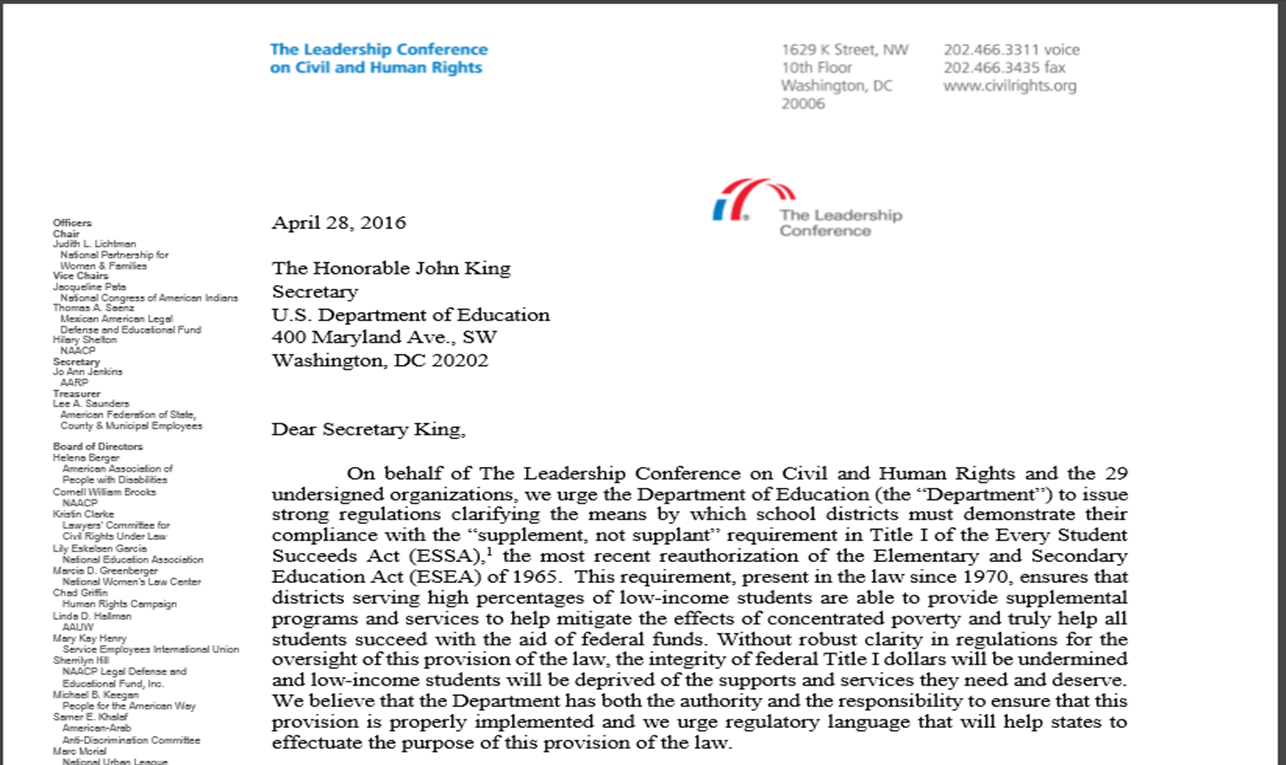
It wasn’t long ago that states like Mississippi admitted that Title I funding was used to build and equip cafeterias and libraries, to hire teachers, and to provide instructional materials and books to Black students that had long been available to White students. This is known in technical terms as “supplanting,” which, albeit less blatantly, many states and districts still do due to weak regulatory oversight. Read the letter we co-signed today with the Leadership Conference on Civil and Human Rights, the NAACP, NCLR, and others urging USDOE, once and for all, to end this shell game and enforce the law’s requirement that Title I funds supplement, not supplant, state and local resources intended for low-income and minority students.

Read letter here.

SNS Letter Image

A Parent’s Heartbreak to See College Dreams Crushed

By Marianne Lombardo

There’s no heartbreak worse than seeing your child struggle. And when they struggle to make a successful college transition, it can impact the rest of their life. In my son’s case, the public K-12 schools and the college of his dreams got paid, but he got a pink slip.

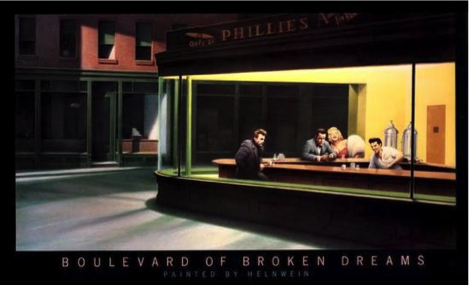
Blvd Broken Dreams

Like all parents, I wanted my kids to achieve success in life. I very purposefully moved us to one of the highest-performing (and very expensive, greatly stretching our middle-class income) suburban districts in the state to assure they would get a good education.

My son’s school experience was generally good. He got mostly good grades and easily passed the Ohio Graduation Test the first time without any issues (attaining a $500 college stipend the state provided). We found a public four-year college with a program that perfectly matched his interests and felt great that we did all we were supposed to do to launch him toward the career of his dreams.

But, it all crashed down. He only attended one quarter. He left because, surprisingly, he was not prepared for the academic demands of college. It was a surprise because it had never been pointed out by his suburban high school that his writing skills were not up to college readiness standards. That surprise deficit did him in.

struggling student
 

The program my son wanted to enroll in at college required students to attain an “A” or “B” in a required introductory course taken during the first quarter. But because of his apparent poor writing skills, he got a “C.” Crushed that he would not be able to attain a degree in the field he had chosen, he dropped out.

My son moved back home with me and enrolled in community college, where he was placed not only in a remedial writing course, but also in a remedial math course. We paid thousands for these courses, to help him relearn what he should have learned in high school, and all the while none of it counted toward a degree. He attended community college on and off for another year and a half before eventually dropping out due to work opportunities and not seeing a clear path toward how college would add value in a career field. He has never finished a college degree and is still paying back student loans.

Our story closely matches data found by my colleagues, Mary Nguyen Barry and Michael Dannenberg, in their report Out of Pocket: The High Cost of Inadequate High Schools and High School Achievement on College Affordability.”

It really hurts to see your kid not be able to attain his dream.

I feel as if our public education system failed him – both the highly acclaimed “public-private” district (where you can’t attend unless you can afford the $300K housing cost) that didn’t adequately prepare him, and the publicly-funded State University that whiplashes kids that didn’t get an adequate preparation from their high school.

I’m not saying kids should get a free pass, but our education system should be doing everything possible to help kids find success. In our experience, there was a complete lack of alignment between what we were told by the district (get good grades), what we were told by the state (pass the Ohio Graduation Test), and the reality that he did not have college readiness skills. The kicker is that once he graduated high school, the problem was ours alone: there was no responsibility or ownership on the part of the district, the state, or the college. We paid the additional price.

Our state has since increased the rigor of its state assessments, and there’s much more opportunity to get ongoing, honest, and objective feedback on how your child is doing based on these assessments every year they are tested. I hope parents understand the value of this information and use it to help if their own child needs intervention before they are cut loose from the K-12 system.

If we had better information, and if the high school had been required to provide intervention for kids that needed shoring up before they left for college, perhaps we would have been left with more than financial costs and a lifetime of wishes for what could have been.

Where Does Bernie Sanders Stand on Public Charter Schools?

By Marianne Lombardo

Where does Bernie Sanders stand on public charter schools? While he’s typically a straight-talker, it’s a little hard to figure out.

On Tuesday’s Tom Joyner Morning Show, Roland Martin asked Sanders:

What do you think about charters and vouchers, which Black parents are extremely supportive of – almost 80%?”

Sanders responded: “If they are private institutions, I do not support, because they are undermining public education in general. If they are in the context of public education, I do support it.”

Martin: “So you support public charter schools?”

Sanders: “Yes. But not private.

Was Sanders saying that he thinks some charter schools are not public schools (for the record, all charter schools are public schools)? Or was Sanders making it a point to distinguish between public and private because Martin’s question also included vouchers?

Sanders’ historical record is not much help answering those questions. He’s vacillated between strong support for public charter schools and what seems like opposition to charter schools based on a mischaracterization of their being private, not public schools.

1998: Long before he ran for President, Bernie not only voted for the Charter School Expansion Act of 1998; he also entered pro-charter testimony in the Congressional Record from a ninth-grade student who said:

While I am fortunate that my family has been able to send me to private school, it should not be only the economically elite who have access to alternative education. I think a solution to this problem is federal legislation encouraging states to institute charter schools. Options would then open up for disadvantaged students. Because charter schools are still technically public schools, any student could go to the school of their choice. Students, like adults, need options; no school fits all students, just like no company is right for all workers.

Note that even this 9th grade student knew the distinction between a private school and a public charter school.

After he launched his Presidential bid, however, Sanders seems to have flipped.

October 2015: Speaking before the Massachusetts Teachers Association, Sanders seemed to accept the notion that charter schools are private schools. When asked:

You mentioned the need to stop privatizing public education. One way to stop that is to make sure that there is a very strong, very reasonable cap on charter schools. I come from a district … where students are leaving in droves to attend these sort-of “miracle” buildings that are the charter schools – and as a result we’re losing valuable funding in already strained budgets. I would hope that in your campaign that you would continue to strive to keep public funding in public schools.”

Bernie responded: “absolutely.

January 2016: At a Town Hall in Newmarket, New Hampshire, Sanders again seemed to imply that he considered charter schools as private schools stating:

I’m not in favor of privately run charter schools. If we are going to have a strong democracy and be competitive globally, we need the best-educated people in the world. I believe in public education.

Does Sanders, unlike the 9th grader whose testimony Sanders inserted in the Congressional Record, not know that charter schools are public schools? Is he misinformed about the fact that all public charter schools are created under public law as part of the public education system, a system that has all kinds of schools e.g., open enrollment, selective admission, magnet, special needs? Is he not aware that public charter schools, unlike private schools, have to accept all students, can’t charge tuition, and are non-sectarian?

Or is Sanders trying to imply that he only considers public charter schools authorized by local districts as part of the public education system, but not those authorized by the state or other agencies empowered by state government to do so? The problem with this is that it would exclude those public charter schools run by non-profit management companies, such as KIPP, YES Prep, GreenDot, and Democracy Prep. Moreover where, in Sanders’ view of the world, would public charter schools not overseen by districts but run by independent groups of teachers, parents and/or community members – the largest group of charter schools – fall?

Bernie’s got a great reputation for speaking plainly. It would be really helpful if he tasked his staff with giving him all the facts about public charter schools and provided clarity to voters on where he stands.

Shavar Jeffries in New York Daily News | The Establishment Bernie Sanders Likes

In the New York Daily News, DFER President Shavar Jeffries calls out the flip-flops and hypocrisy in Bernie Sanders’ education record.

As the next round of hand-wringing over the Democratic race commences, those of us who are focused on education policy have our own questions.

First, why, when Democrats need a broad coalition of Latino and African-American voters, are our candidates shying away from an issue that consistently ranks at the top of those voters’ concerns-access to high-quality education?

And, second, why is no one calling out the flip-flops and hypocrisy in Bernie Sanders’ record on education? It reinforces his greatest perceived weakness — that he is incapable of putting together the diverse coalition necessary to win. And it undermines his greatest strength — the perception that he is ideologically consistent.

Read more here in the New York Daily News.

Highlights from Education Week’s 2016 Quality Counts Report

By Marianne Lombardo

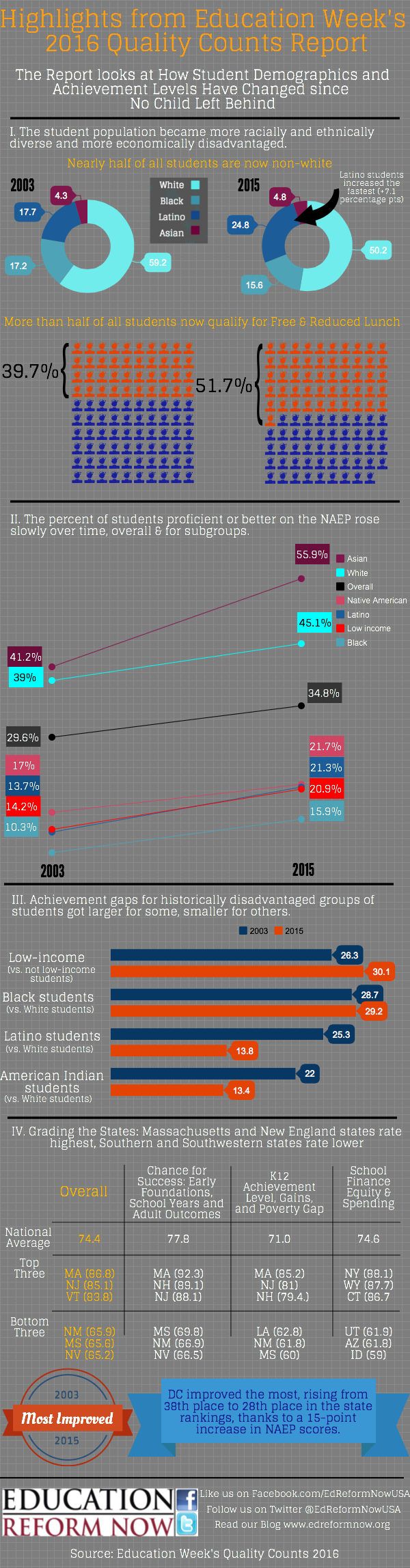
Education Week’s annual Quality Counts Report explores different themes throughout the years – such as standards, teaching, early childhood, special education, finance, globalization, and discipline.

The 20th edition, Quality Counts 2016, “Called to Account: New Directions in School Accountability”, takes a deep look at education accountability, an extremely important topic as the nation transitions to new accountability systems under the Every Student Succeeds Act.

The report:

  • Examines changes in student demographics and achievement since 2003.
  • Grades the states by computing a Chance-for-Success Index, a K-12 Achievement Index, and a school finance analysis for each state, and
  • Explores changes in accountability systems we’ll see with the new federal law, where having good data to compare states will be more important than ever.

In a nutshell:

  • The student population became more racially and ethnically diverse and more economically disadvantaged;
  • Achievement levels for all demographic groups rose slowly over time;
  • Achievement gaps between low-income students and their more advantaged peers increased slightly (about 4 percentage points);
  • Achievement gaps between black students and their white peers stayed roughly the same;
  • Achievement gaps between American Indian and Latino students, and their White, non-Hispanic peers decreased by roughly 50%;
  • Massachusetts and other Northeastern states rank high, whereas southern and southwestern states tend to rate lower; and
  • DC improved more than any of the 50 states.

2016 Quality Counts

our newsletter.