
DFER NY Joins Sen. Gounardes & Assemblywoman Walker to Ban College Admissions that Favor the Wealthy

DFER NY Joins Sen. Gounardes & Assembly Member Walker to Ban College Admissions that Favor Wealthy Students

New legislation to prohibit legacy, early admissions policies in higher education

NEW YORK, N.Y. (March 9, 2022)—Democrats for Education Reform New York (DFER NY) Director Jacquelyn Martell joined New York State Senator Andrew Gounardes and Assemblywoman Latrice Walker today to unveil The Fair College Admissions Act, aimed at banning the legacy preference and binding early college admission policies sponsors say discriminate against racial minority, working class, and low-income students.

Approximately 50 New York State colleges provide legacy students—applicants who are descendants of alumni—an admissions preference. Almost one-third additionally provide an admission boost to those who apply early and commit to attend prior to seeing a financial aid package.

At top 30 universities, legacy students have a 45% greater chance of being admitted than equally qualified non-legacy students, while early decision applicants comprise up to 50% of the class at top schools, with an applicant pool that is more than three times as white as the regular decision applicant pool.

“Getting into the college of your choice should be a matter of ability and hard work. It should not be based on one’s family connections or ability to accept an offer without knowing about financial aid options,” said Sen. Gounardes. “That’s why Assembly Member Walker and I plan to end inequitable admissions policies with the Fair College Admissions Act. And for schools that persist with exclusionary admissions practices, our bill would assess penalties that would be used to support college affordability that are open and inclusive to all, further contributing to the economic success and mobility that all New Yorkers deserve.”

The new legislation will be enforced by charging a penalty to any institutions who do not follow the law, with the revenue from any penalties earmarked for low-income students statewide.

Recent polling from Public Policy Polling, commissioned by DFER NY partner education Reform Now Advocacy, found New York City voters favor banning the legacy preference by a near two-to-one margin (56% v. 30%) and discouraging early decision by the nearly the same (54% v. 35%).

“New York colleges should fairly provide a pathway of opportunity for all students, not serve as a gatekeeper for those already facing the greatest obstacles,” said DFER NY’s Martell. “I am proud to join with Senator Gounardes and Assembly member Walker in their push to make New York the first state in the nation to call for an end to both of these unjust policies.”

“The legacy preference and binding early decision are essentially affirmative action policies for the wealthy,” said Michael Dannenberg, vice president for higher education at Education Reform Now who first began working on the issue as aide to the late Sen. Edward Kennedy (D-MA). “Admission to college should be based on qualifications of an applicant, not who their parents are or how much money they have. The New York legislation offers a national model for how states can tackle unfair admissions policies and hold colleges accountable for making a meaningful commitment to diversity and opportunity.”

You can view the full legislation here, as well as additional quotes from supporters below.

“For too long students from well-connected and wealthy families have benefitted from their privilege in the college admissions process while first-generation and low-income students lose out,” said Congressman Jamaal Bowman, Ed.D. (NY-16). “As a former educator I believe that education should disrupt inequality, not perpetuate it, and that is exactly why I have been fighting at the federal level to ban legacy admissions. The legislation introduced by New York State Senator Andrew Gounardes and Assembly Member Latrice Walker supports our efforts to address unequitable admissions practices by prohibiting legacy preference and early decision policies at colleges and universities across New York State. Together, we must continue working to support our students and ensure equity in education.”

“Legacy admissions are inherently unfair; promising students are hurt by this policy,” said Claire Tempelman, student advocate at Cornell University. “It’s a relic of an earlier time and goes against values of justice and merit. As a representative of students at Cornell I know my peers are against this policy despite having the most to gain from it. When our Student Assembly passed a unanimously supported resolution to end the legacy preference, Cornell’s president vetoed us. It is time these institutions and the states that support them listen to students.”

Chara Abiah Lyons, New York City Public Schools alumna and Dartmouth College college student, said, “I applied through binding early decision to Dartmouth. Now I am transferring to another school and wish I had had more options as a college applicant. The pressures of affordability pushed me to Early Decision along with a lack of resources in my school and family. This bill will make sure every student has options.”

##

About DFER NY 
DFER NY Political Action Committee committed to advancing educational equity for New York’s students. DFER-NY has recently worked to advance teacher diversification legislation, reduce the cost of broadband internet access for families, and increase funding for public charter schools. It is the partner organization of Education Reform Now Advocacy New York, a 501(c)4 advocacy organization that funds and supports legislative and political advocacy, and the affiliate organization of Education Reform Now New York, a 501(c)(3) non-partisan, nonprofit think tank and advocacy organization that promotes increased resources and innovative reforms in K-16 public education, particularly for low-income students and students of color. DFER NY is a chapter of the national organization, Democrats for Education Reform.
 

Jacquelyn Martell to Lead DFER NY as State Director

NEW YORK, N.Y. (Feb. 1, 2022)—Democrats for Education Reform (DFER) announced today that Jacquelyn Martell has been named the next director for DFER New York and its affiliate Education Reform Now New York.
In her new role, Martell will lead the chapter’s mission to develop a student-centered policy agenda rooted in educational equity and excellence. Priority issues include accelerating learning for all students—particularly for historically underserved students and those most impacted by the pandemic, promoting higher education access and affordability within the state, and overall, fighting for higher achievement and greater opportunities for all students in New York. 


“Jacquelyn has been a tremendous leader and advocate for children and families. Most recently, she was instrumental in cultivating critical relationships with the community, elected officials and key stakeholders in a $35 million school expansion project within Brooklyn—providing high quality public education options to more than 3,000 students within the East New York area,” said DFER National President Shavar Jeffries. “She spearheaded a robust parent program during the pandemic to engage hundreds of parents, and helped expand Achievement First’s high quality charter network to 91 students in Queens—73% of whom receive free and reduced price lunch and 100% of whom are students of color. I am confident that Jacquelyn has the expertise, bold vision, and passion necessary to lead New York toward a brighter, more equitable future for all children.”


Martell previously served as the State Director of External Relations and Advocacy for Achievement First Public Charter Schools, is a graduate of the Broad Center Residency in Education Leadership, and served as an organizer with the Service Employees International Union, among other notable achievements.


“Education is the linchpin of all social issues. That’s why it is critical that we fight to provide an opportunity-creating public education to all children within this country,” said Martell. “I was lucky to have parents and community members advocating on my behalf, but I’ve seen too often how a lack of access to a quality education can have an adverse impact on a child’s trajectory. Together with DFER, I can continue the fight to create an equitable and accessible system so all our children can access their full potential.”
DFER NY was established in 2007 to advocate for educational equity for nearly 3 million students in New York public schools. 

##

About DFER NY
DFER NY Political Action Committee committed to advancing educational equity for New York’s students. DFER-NY has recently worked to advance teacher diversification legislation, reduce the cost of broadband internet access for families, and increase funding for public charter schools. It is the partner organization of Education Reform Now Advocacy New York, a 501(c)4 advocacy organization that funds and supports legislative and political advocacy, and the affiliate organization of Education Reform Now New York, a 501(c)(3) non-partisan, nonprofit think tank and advocacy organization that promotes increased resources and innovative reforms in K-16 public education, particularly for low-income students and students of color. DFER NY is a chapter of the national organization, Democrats for Education Reform.
 

##

Democrats for Education Reform New York Congratulates Eric Adams on his Primary Victory in the Race for NYC’s Next Mayor  

Democrats for Education Reform New York Congratulates Eric Adams on his Primary Victory in the Race for NYC’s Next Mayor  

New York, N.Y. (July 7, 2021) Democrats for Education Reform-New York (DFER-NY) is excited to congratulate Eric Adams on his victory in the New York City Democratic Mayoral Primary. We, along with our coalition partners, are prepared to be a resource for Adams by providing data-backed recommendations and strategies in working together to advance equity in New York City’s schools for all students. 

As disparities persist across the city for students of color and those from high-need communities, it’s critical that New York’s next Mayor select a Chancellor who can advocate for educational equity. As Adams prepares to select his team, we are encouraged by voters who, according to our partner’s latest poll, want a chancellor who has experience addressing inequities that these communities face. 

After learning for over a year in a global pandemic, our city’s students will need an administration that advocates for both their academic and social and emotional wellbeing. We must work together with New York City’s next mayor to make policies that benefit those who need it most and uplift their voices in the process. This path must include bridging the digital divide and diversifying the teacher workforce through increased access for educators of color.  

Adams has already prioritized integration efforts in NYC schools and believes in using the lessons from remote learning through the pandemic as an opportunity to expand students’ options and digital access. We are also encouraged by his inclusion of universal screening for dyslexia as part of his education plan and are ready to assist in this fight for increased literacy and equitable resource distribution. 

DFER-NY extends our congratulations to Adams and we look forward to his continued leadership in working toward a more equitable future for New York City Public Schools.

##

New York Voters Need to be Educated on Ranked Choice Voting to Ensure Their Ballot Counts This Election

The 2021 NYC primary elections are rapidly approaching—and as an increasing number of individuals file for candidacy each day, it is on track to be the largest municipal race that not only this city, but this country has seen. But there is another factor that makes this election historically significant—it will be the first time that the Ranked-Choice Voting (RCV) method is used on a ballot in New York.

Another predicted historical stat for the race? It will have the dubious “honor” of bringing with it the lowest amount of voter awareness or understanding of the most critical part of an election: the voting process itself.

In RCV, voters are able to select multiple candidates that they support and rank their choices in descending order. Since ballots are counted through multiple elimination rounds until a candidate reaches a plurality of votes, each name a voter ranks could potentially be tallied.

This method has a significant impact on the way voters may engage with candidates and approach their ballots, and may be extremely confusing if the voter hasn’t been adequately educated on the process or given time to process the change. Yet, the only form of distributed education on this issue has been an FAQ sheet posted on the NYC Campaign Finance page—a place few voters would go to seek out information on an issue that almost half aren’t even aware exists.

In numerous statements, the NY Board of Elections and NYC Campaign Finance have mentioned the creation of education platforms and resources in order to best reach out to communities, especially those of color. But as of now, there have been minimal steps taken toward disseminating these resources en masse, leaving many people uninformed and ill-equipped to participate in the election process.

By moving forward with RCV without educating large portions of the population directly affected by this change, these officials are failing in their due-diligence and jeopardizing voters’ right to participate in a truly fair election.

Four of the biggest concerns around moving forward with Ranked-Choice Voting:

  1. The majority of the voters did not vote for the amendment in 2019. Although the actual ballot passed with over 70 percent of support from NY voters as noted on the NY Campaign Finance page, that 73.5 percent only accounts for 40 percent of registered voters that actually voted in that 2019 election—therefore this does not accurately represent the registered voter base in its entirety.
  2. There has been little to no education done on how the actual system works. The New York Board of Elections has stated that they hope to roll out an education platform alongside the New York Campaign Finance Board including the launch of a $1 million campaign that includes mailing postcards to voters—but this feels like too little, too late. Many prominent elected officials across the city have vocalized their opposition to starting the voting system in the upcoming special elections but have failed in changing the verdict after filing a lawsuit in early December.
  3. The system overall is confusing and is not well-publicized. The new method is a complete 180 from the widely understood concept of one voice, one vote. Without properly addressing this significant change, the new system will be a disadvantage to both the voters it’s made to serve and the system it’s meant to aid.
  4. Voter Turnout could be low due to the lack of momentum around RCV, especially in communities of color. Without properly reaching and educating these groups that have been historically discriminated against, the system is contributing to the disenfranchisement of black and brown communities and suppressing their voice—an all too familiar narrative that should not and cannot be repeated.

This is not to say that Ranked-Choice Voting shouldn’t someday be implemented and seen as a progressive shift in our democracy. Rather, it is to say that there isn’t enough education currently on this new voting method, which could lead to further complications for those who vote.

The reality is that many voters will simply be turned away if there isn’t adequate information provided and distribution of education administered to them in time. Primaries are already set to have a far less turnout than General Elections, especially in non-major election years, so the chance to lose more voters is not something we can accept.

Without a dramatic movement to educate and prepare all voters, the New York City Board of Elections should untether itself from continuing Ranked-Choice Voting for this upcoming year. This is a monumental change to the way voters use their voice, and how candidates win an election; so it needs to be done right, or not at all.

ERNA NY Launches Campaign with Voto Latino to Drive Early Voting 

ERNA NY Launches Campaign with Voto Latino to Drive Early Voting 

New York, N.Y. (October 23, 2020) — Education Reform Now Advocacy New York (ERNA-NY), an affiliate of Democrats for Education Reform New York (DFER-NY), and Voto Latino are excited to announce a collaborative effort to increase voter turnout among communities of color in New York.

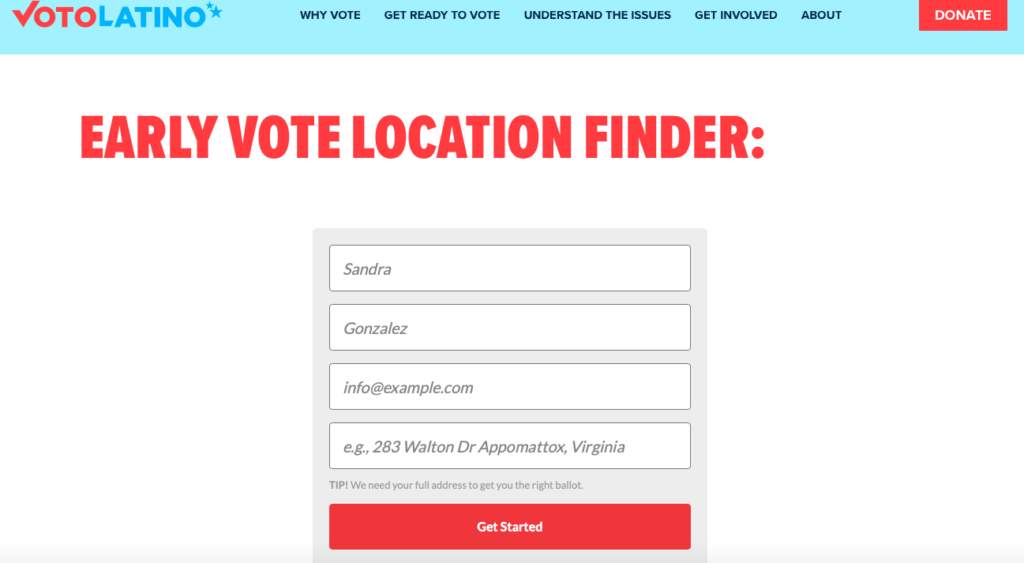
Together, ERNA-NY and Voto Latino launched a digital campaign this week that will specifically target Latinx, African American, and Asian communities in New York City, Long Island, and Westchester counties to encourage people to vote in person and early. By utilizing a digital platform, the organizations hope to encourage voters to take advantage of their option to vote early by clicking on the ad and easily finding their closest voting location. 

“By reaching out to this multi-racial coalition of voters, and giving them a quick way to access their designated early in-person voting location, we aim to make the voting experience as easy as possible,” said DFER NY State Director Crisanta Duran. “Those who join us and vote early and in person will only add to this already record-breaking movement, ensuring that their voices have been heard, and their votes counted.”

“Making sure our communities of color are equipped and ready to vote is critical as we near the end of this election season,” said María Teresa Kumar, President and CEO of Voto Latino. “The more inclusive and accessible voting becomes, the stronger our democracy will be. Voting early is the best way to exercise the right to vote in a safe and physically distanced way.” 

New Yorkers can use the platform to find their early voting location here.

Find where you can vote early in NY.

Early voting across New York State begins tomorrow, Saturday, Oct. 24, and will continue until Sunday, Nov. 1. 

###

Education Reform Now Advocacy New York is the 501(c)(4) nonprofit partner of Democrats for Education Reform New York, a political action committee that seeks to elect leaders who will support policies that benefit all students—particularly Black and Latino students. ERNA’s advocacy group supports DFERs legislative and political advocacy work.

our newsletter.